
States With No Income Tax (2026): All 9 + Take-Home Pay
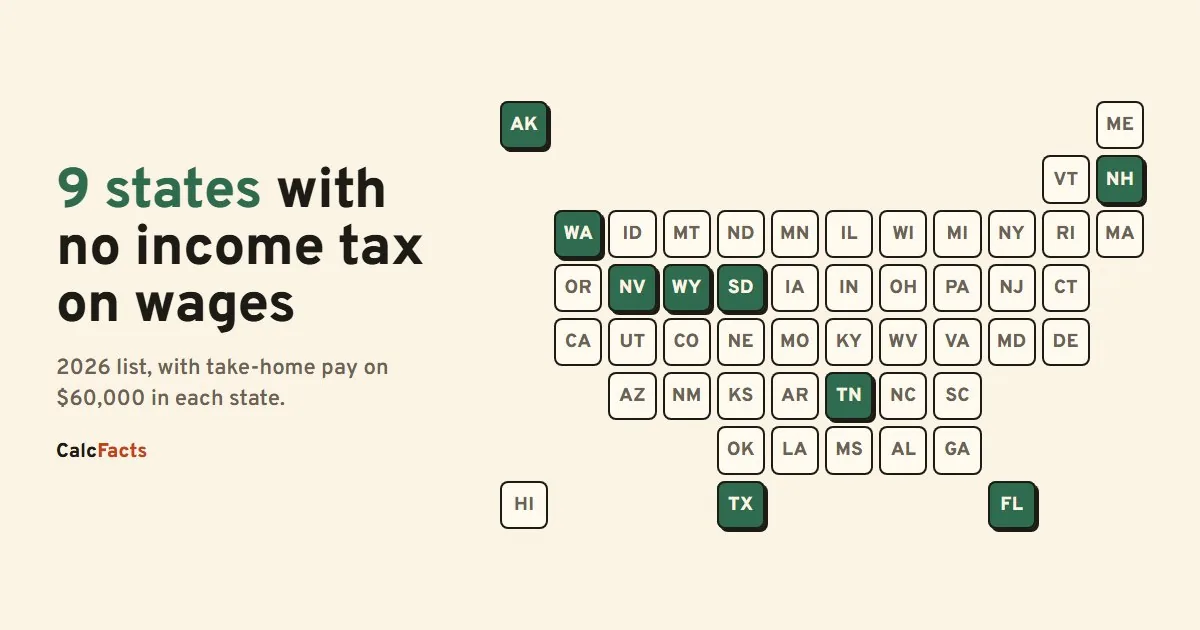
Nine states have no income tax on wages in 2026: Alaska, Florida, Nevada, New Hampshire, South Dakota, Tennessee, Texas, Washington and Wyoming. If you work in one of them, your employer withholds federal income tax, Social Security and Medicare, but no state income tax. On a $60,000 salary paid every two weeks, that leaves $1,938.07 per paycheck in most of these states, about $2,340 a year more than in the typical state that taxes wages.
“No income tax” doesn’t always mean no state deductions, though. Alaska and Washington still take small payroll premiums, and Washington has a capital gains tax and a new income tax on very high incomes coming in 2028. This guide covers all nine, with real take-home figures from our paycheck calculator.
Last updated November 3, 2026 · Tax review: pending sign-off by a licensed tax professional (EA/CPA)
Key Takeaways
- Nine states don’t tax wages: Alaska, Florida, Nevada, New Hampshire, South Dakota, Tennessee, Texas, Washington and Wyoming.
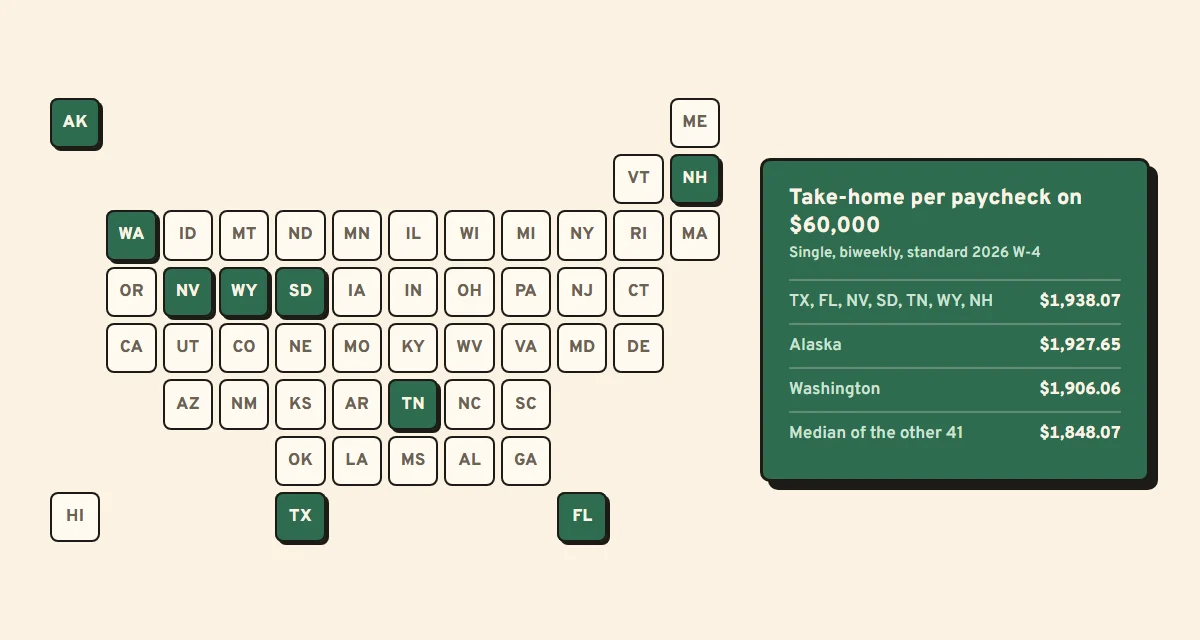
- Take-home on $60,000 (single, biweekly): $1,938.07 in seven of them, $1,927.65 in Alaska and $1,906.06 in Washington, against a median of $1,848.07 in the other 41 states.
- The yearly gap is about $2,340 on $60,000 and $4,446 on $100,000 compared with the median income-tax state, and about $4,657 and $8,110 compared with Oregon.
- Alaska and Washington still have payroll premiums: unemployment insurance in Alaska, and paid leave and WA Cares in Washington.
- Washington taxes long-term capital gains, and a 9.9% income tax on adjusted gross income over $1 million starts January 1, 2028.
In this guide
- The 9 States With No Income Tax
- Take-Home Pay in Each State
- No Income Tax Doesn’t Mean No Payroll Deductions
- The Fine Print: Washington, New Hampshire and Tennessee
- Is It Better to Live in a State With No Income Tax?
- Frequently Asked Questions
The 9 States With No Income Tax
For all 50 states ranked on $40,000, $60,000 and $100,000, see our take-home pay by state data study.
| State | Tax on wages | Still on your paycheck (state) | Basis |
|---|---|---|---|
| Alaska | None | Unemployment insurance, 0.5% | Alaska Department of Revenue |
| Florida | None | Nothing | Florida Constitution, Art. VII §5 |
| Nevada | None | Nothing | Nevada Department of Taxation |
| New Hampshire | None | Nothing | New Hampshire DRA |
| South Dakota | None | Nothing | South Dakota DOR |
| Tennessee | None | Nothing | Tennessee DOR |
| Texas | None | Nothing | Texas Constitution, Art. 8 §24-a |
| Washington | None | Paid Family & Medical Leave, WA Cares (0.58%) | Washington DOR |
| Wyoming | None | Nothing | State of Wyoming |
Nevada’s Department of Taxation puts it plainly: “Nevada residents do not pay state tax on income earned from salaries, wages, or similar compensation.” Washington’s Department of Revenue says the state “does not currently have an individual income tax.” Each state calculator linked above lists its own sources and what else, if anything, comes out of a paycheck there.
Take-Home Pay in Each State
On $60,000 a year, the seven states with no state payroll deductions all leave the same amount: $1,938.07 per biweekly paycheck, because only federal income tax ($193.08), Social Security ($143.08) and Medicare ($33.46) come out. Alaska and Washington are slightly lower because of their payroll premiums.
| State | Take-home on $60,000 (per paycheck) | Take-home on $100,000 (per paycheck) |
|---|---|---|
| Florida, Nevada, New Hampshire, South Dakota, Tennessee, Texas, Wyoming | $1,938.07 | $3,045.38 |
| Alaska | $1,927.65 | $3,034.96 |
| Washington | $1,906.06 | $2,992.03 |
| Median of the other 41 states | $1,848.07 | $2,874.38 |
| Oregon (lowest take-home of all 50 at both salaries) | $1,758.96 | $2,733.44 |
All figures are for a single filer with a standard 2026 federal W-4, paid every two weeks, with no 401(k) or other deductions, using each state calculator’s default settings; Alaska’s figure spreads its $271 yearly unemployment contribution evenly (methodology).
Over a year, that’s about $2,340 more in a no-tax state than in the median income-tax state on $60,000 ($90 per paycheck × 26), and about $4,657 more than in Oregon. On $100,000, the gaps grow to about $4,446 and $8,110. The difference isn’t always large: North Dakota, which withholds nothing on the first $57,625 of a single filer’s yearly pay under its 2026 withholding tables (see our North Dakota calculator), takes home $1,936.07 on $60,000, just $2.00 less than Texas.
For any salary, see salary pages with take-home pay in all 50 states, or open the calculator for your state.
No Income Tax Doesn’t Mean No Payroll Deductions
Federal taxes apply whatever the state: federal income tax withholding, Social Security at 6.2% of wages up to $184,500 in 2026, and Medicare at 1.45% (IRS Topic No. 751). Our guide to pay stub tax codes explains each line.
Two of the nine states add their own payroll items:
- Alaska: employees in jobs covered by unemployment insurance pay 0.5% of wages toward unemployment insurance, up to $54,200 of wages in 2026, so at most $271 a year (Alaska Department of Labor, 2026 rates). On $60,000, your employer takes about $11.54 a paycheck until your 2026 wages reach $54,200 (around the 24th paycheck), then nothing; our figures show $10.42, the $271 yearly total spread evenly.
- Washington: employees pay a Paid Family and Medical Leave premium (Washington ESD) and the WA Cares Fund premium of 0.58% of wages (WA Cares Fund). On $60,000, they come to $18.63 and $13.38 per paycheck. Some workers qualify for a WA Cares exemption (WA Cares, exemptions).
The Fine Print: Washington, New Hampshire and Tennessee
Washington. Wages aren’t taxed, but the state does tax some gains and, from 2028, very high incomes:
- A capital gains tax applies to individuals’ long-term capital gains from selling assets such as investments. The 2021 law created it at 7%, and the standard deduction for 2025 was $278,000 (Washington DOR, Capital gains tax). Sales of real estate and of assets held in certain retirement accounts are exempt. The Department of Revenue’s page also links a notice about tiered rates, so check it for the rate on a large gain. Most wage earners never pay it.
- Starting January 1, 2028, “a new 9.9% income tax will apply to individuals and married couples filing jointly with annual adjusted gross income exceeding $1 million” (Washington DOR, Income tax). It doesn’t affect 2026 paychecks.
New Hampshire. New Hampshire’s Department of Revenue Administration says the state “does not have an income tax on an individual’s reported W-2 wages,” but it used to tax interest and dividends, at 5% and then 4% and 3% in its last two years. That tax was repealed for taxable periods beginning after December 31, 2024 (New Hampshire DRA), so 2025 is the first year with no tax on that income either.
Tennessee. Tennessee doesn’t tax wages, and employers there have no state income tax to withhold (Tennessee DOR, GEN-34). Its old tax on interest and dividends, the Hall income tax, was repealed as of January 1, 2021; our Tennessee calculator has the details.
Working in more than one state. Living in a no-tax state doesn’t shield pay you earn in a state that taxes wages. For example, if you live in New Hampshire and work in Massachusetts, Massachusetts tax is withheld on your Massachusetts wages (830 CMR 62B.2.1). If you work across state lines, check the calculator for the state where you work; some, such as Connecticut, Kansas and Louisiana, explain their rules for workers who live elsewhere.
Is It Better to Live in a State With No Income Tax?
For take-home pay alone, usually: on $60,000, a paycheck in seven of the no-tax states is about $90 larger every two weeks than in the median income-tax state, and about $80 larger in Alaska and $58 larger in Washington. It isn’t true of every pair of states: North Dakota’s $1,936.07 is more than Alaska’s $1,927.65 and Washington’s $1,906.06. Whether that makes a state “better” depends on what else you pay there, such as sales tax, property tax, housing and insurance, which this guide doesn’t compare.
If you’re comparing a job offer in two states, run the same salary through both state paycheck calculators and compare the net pay line. Our guide to gross vs net pay shows how to read the difference.
Frequently Asked Questions
What states have no income tax in 2026?
Alaska, Florida, Nevada, New Hampshire, South Dakota, Tennessee, Texas, Washington and Wyoming. None of them taxes wages. New Hampshire’s tax on interest and dividends ended for taxable periods beginning after December 31, 2024.
How can Florida have no income tax?
Florida’s constitution limits the state from taxing the income of residents who are natural persons (Florida Constitution, Art. VII §5). For workers, that means no state income tax withholding: a $60,000 salary takes home $1,938.07 every two weeks in our Florida paycheck calculator.
Does Washington have an income tax?
Not on wages in 2026. Washington taxes long-term capital gains above a standard deduction, and a 9.9% income tax on adjusted gross income over $1 million begins January 1, 2028 (Washington DOR). Washington paychecks do include Paid Family and Medical Leave and WA Cares premiums.
Do I pay federal income tax in a state with no income tax?
Yes. Federal income tax, Social Security and Medicare apply in every state. A state without an income tax only removes the state income tax line.
Which no-income-tax state has the highest take-home pay?
On a regular salary, seven tie: Florida, Nevada, New Hampshire, South Dakota, Tennessee, Texas and Wyoming all leave $1,938.07 per biweekly paycheck on $60,000 in our calculators. Alaska ($1,927.65) and Washington ($1,906.06) are a little lower because of their payroll premiums.
The Bottom Line
- Nine states don’t tax wages in 2026: Alaska, Florida, Nevada, New Hampshire, South Dakota, Tennessee, Texas, Washington and Wyoming.
- On $60,000, seven of them leave $1,938.07 every two weeks, about $2,340 a year more than the median state that taxes wages.
- Alaska and Washington still take small payroll premiums, and Washington taxes capital gains and will tax incomes over $1 million from 2028.
To see your own numbers, pick your state in the paycheck calculator.
Sources
- Washington Department of Revenue, Income tax
- Washington Department of Revenue, Capital gains tax
- Nevada Department of Taxation, Income Tax in Nevada
- Florida Constitution, Article VII, Section 5
- Texas Constitution, Article 8, Section 24-a
- New Hampshire Department of Revenue Administration, Interest and Dividends Tax
- Tennessee Department of Revenue, GEN-34 Income Tax Withholding
- South Dakota Department of Revenue, Taxes for individuals
- Alaska Department of Revenue, Annual Report
- State of Wyoming, About Wyoming
- Alaska Department of Labor, 2026 unemployment insurance rates
- Washington Employment Security Department, 2026 Paid Family and Medical Leave premium
- WA Cares Fund, FAQ and exemptions
- IRS Topic No. 751, Social Security and Medicare Withholding Rates
- Massachusetts DOR, 830 CMR 62B.2.1, Withholding of Taxes on Wages