
Take-Home Pay by State 2026: $40k, $60k, $100k in All 50 States
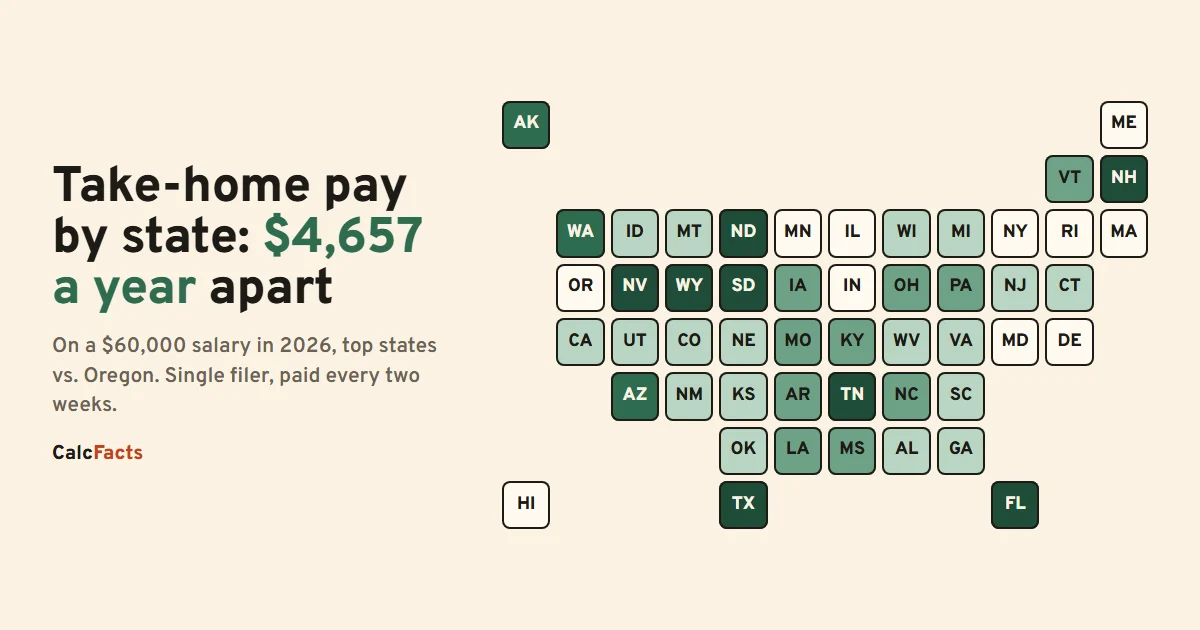
On a $60,000 salary in 2026, a single worker paid every two weeks takes home $1,938.07 per paycheck in the seven states that withhold nothing at the state level (Florida, Nevada, New Hampshire, South Dakota, Tennessee, Texas and Wyoming) and $1,758.96 in Oregon. That’s $179.11 a check, or about $4,657 a year. The gap is about $3,240 a year at $40,000 and $8,110 at $100,000.
We ran the same paycheck through all 50 state calculators on our site, with identical assumptions. Every number below comes from that engine, and you can rerun any state yourself on its calculator page.
Published 7 November 2026. Data reflects 2026 withholding rules in effect on that date.
Key Takeaways
- At $60,000, 7 states tie for the most take-home pay: Florida, Nevada, New Hampshire, South Dakota, Tennessee, Texas and Wyoming. That’s $1,938.07 per biweekly check.
- The five states with the least take-home at $60,000 are Oregon, Maryland, Hawaii, Minnesota and New York.
- The yearly gap between the top and bottom state grows with pay: $3,240 at $40,000, $4,657 at $60,000 and $8,110 at $100,000.
- Sixteen states take a payroll premium for programs like paid leave or disability insurance. Rankings that count only income tax leave these out, even though they come out of the paycheck.
How We Ran the Numbers
Each state gets the same worker:
- single filer with a standard 2026 Form W-4 and no adjustments
- paid biweekly, so 26 paychecks a year
- no 401(k) or other pre-tax benefits
- each state’s default withholding inputs (for example, one allowance where a state form asks for allowances)
Federal income tax follows the IRS percentage method in Publication 15-T (2026). Social Security is 6.2% of pay up to the $184,500 wage base and Medicare is 1.45%, per IRS Publication 15 (2026). State withholding formulas and premium rates come from each state’s own tables. They’re listed with their sources and test cases on our paycheck calculator methodology page.
A few more details matter if you want to reproduce the numbers:
- Rules as of 7 November 2026. Paychecks earlier in 2026 may differ in states that changed formulas mid-year, such as Ohio (1 August), Indiana (1 October) and Georgia (4.99% from 11 May).
- Defaults that pick a rate. Maryland uses Montgomery County’s 3.2% county rate, Indiana uses Marion County, and Arizona uses the 2.0% rate that applies when no Form A-4 is filed. Each state’s calculator page shows the inputs we used.
- Capped premiums. Some state premiums stop at a yearly wage cap: Alaska unemployment insurance at $54,200 of wages, New Jersey unemployment and workforce at $44,800, and New York Paid Family Leave at $411.91 a year. We show the yearly total spread evenly over 26 checks, the same way our calculators do. Real paychecks show more early in the year and nothing once the cap is reached.
- Rounding. Per-check figures are rounded to the cent. Yearly figures are the per-check amount × 26.
- Tests. We check all 150 rows automatically: the line items add up to take-home, Social Security and Medicare are exactly 6.2% and 1.45%, and each $60,000 figure matches that state’s calculator page.
These are withholding figures: what comes out of each paycheck. Your actual tax for the year, and any refund, depends on your whole return. Gross pay is the same everywhere ($2,307.69 per check at $60,000), and so are federal income tax ($193.08) and Social Security plus Medicare ($176.54). The only thing that changes from state to state is what the state, and in two states the county, takes.
States With the Highest Take-Home Pay
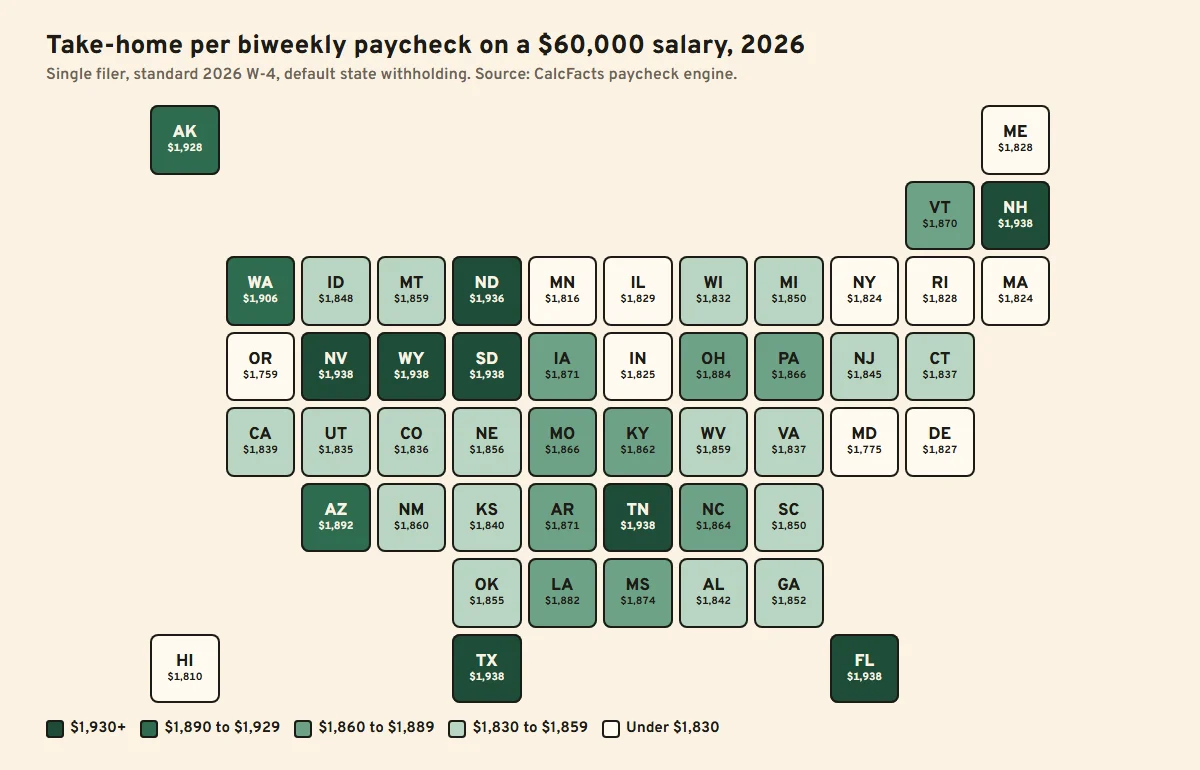
The top 10 are the nine states with no income tax on wages plus North Dakota. We cover the nine in detail in states with no income tax. They don’t all land on the same number:
- Florida, Nevada, New Hampshire, South Dakota, Tennessee, Texas and Wyoming take nothing at the state level, so the paycheck is $1,938.07 at $60,000.
- North Dakota taxes income, but its 2026 withholding table withholds nothing on the first $57,625 of a single filer’s yearly wages. A $40,000 earner has nothing withheld for the state. At $60,000 it withholds $2.00 a check, leaving $1,936.07.
- Alaska withholds 0.5% of wages for unemployment insurance, up to $54,200 of wages a year. Spread over the year, the check is $1,927.65.
- Washington takes premiums for paid family leave and the WA Cares long-term care fund, leaving $1,906.06.
States With the Lowest Take-Home Pay
At $60,000, the five states with the least take-home are Oregon, Maryland, Hawaii, Minnesota and New York. Oregon is last at every salary we tested. Its state income tax withholding is the highest of any state ($162.95 a check at $60,000), and its transit tax and paid leave premium ($16.16) push it below Maryland, even though Maryland’s state and county withholding together ($163.28) is slightly higher than Oregon’s state withholding.
Maryland lands near the bottom for a different reason. Its state withholding ($97.56 at $60,000) is moderate, but Maryland also withholds a county income tax, which our default includes at Montgomery County’s 3.2% rate ($65.72 a check). Maryland’s county rates run from 2.25% to 3.3% in 2026. Even at the lowest rate, take-home at $60,000 ($1,794.30) would still rank 49th, ahead of only Oregon. Indiana’s default also includes a county tax (Marion County).
The bottom five changes with income:
- At $40,000: Oregon, Maryland, Indiana, Rhode Island and Massachusetts.
- At $100,000: Oregon, Maryland, California, Hawaii and Minnesota. California enters the list as its graduated rates climb.
The national median take-home at $60,000 is $1,855.72 per check. Among the 41 states that tax wages, it’s $1,848.07.
2026 Take-Home Pay by State at $40k, $60k and $100k (Full Table)
Ranked by take-home per biweekly paycheck on $60,000. “State + local tax” is state income tax withholding plus any county tax in our default. “Premiums” are state payroll programs such as paid leave, disability insurance or unemployment insurance, plus Oregon’s statewide transit tax. Click a state to run your own numbers.
| Rank | State | $40k | $60k | $100k | State + local tax at $60k | Premiums at $60k |
|---|---|---|---|---|---|---|
| 1 | Florida | $1,320.00 | $1,938.07 | $3,045.38 | $0.00 | $0.00 |
| 1 | Nevada | $1,320.00 | $1,938.07 | $3,045.38 | $0.00 | $0.00 |
| 1 | New Hampshire | $1,320.00 | $1,938.07 | $3,045.38 | $0.00 | $0.00 |
| 1 | South Dakota | $1,320.00 | $1,938.07 | $3,045.38 | $0.00 | $0.00 |
| 1 | Tennessee | $1,320.00 | $1,938.07 | $3,045.38 | $0.00 | $0.00 |
| 1 | Texas | $1,320.00 | $1,938.07 | $3,045.38 | $0.00 | $0.00 |
| 1 | Wyoming | $1,320.00 | $1,938.07 | $3,045.38 | $0.00 | $0.00 |
| 8 | North Dakota | $1,320.00 | $1,936.07 | $3,013.38 | $2.00 | $0.00 |
| 9 | Alaska | $1,312.31 | $1,927.65 | $3,034.96 | $0.00 | $10.42 |
| 10 | Washington | $1,298.66 | $1,906.06 | $2,992.03 | $0.00 | $32.01 |
| 11 | Arizona | $1,289.23 | $1,891.92 | $2,968.46 | $46.15 | $0.00 |
| 12 | Ohio | $1,288.67 | $1,883.74 | $2,945.05 | $54.33 | $0.00 |
| 13 | Louisiana | $1,287.76 | $1,882.06 | $2,941.84 | $56.01 | $0.00 |
| 14 | Mississippi | $1,287.00 | $1,874.07 | $2,919.38 | $64.00 | $0.00 |
| 15 | Arkansas | $1,281.81 | $1,871.42 | $2,911.15 | $66.65 | $0.00 |
| 16 | Iowa | $1,282.08 | $1,870.92 | $2,919.77 | $67.15 | $0.00 |
| 17 | Vermont | $1,278.79 | $1,870.24 | $2,874.42 | $65.29 | $2.54 |
| 18 | Missouri | $1,284.00 | $1,866.07 | $2,900.38 | $72.00 | $0.00 |
| 19 | Pennsylvania | $1,271.69 | $1,865.60 | $2,924.61 | $70.85 | $1.62 |
| 20 | North Carolina | $1,277.00 | $1,864.07 | $2,908.38 | $74.00 | $0.00 |
| 21 | Kentucky | $1,270.68 | $1,861.82 | $2,915.29 | $76.25 | $0.00 |
| 22 | New Mexico | $1,277.72 | $1,859.89 | $2,892.92 | $78.18 | $0.00 |
| 23 | Montana | $1,277.00 | $1,859.07 | $2,880.38 | $79.00 | $0.00 |
| 23 | West Virginia | $1,275.00 | $1,859.07 | $2,895.38 | $79.00 | $0.00 |
| 25 | Nebraska | $1,272.63 | $1,856.37 | $2,893.73 | $81.70 | $0.00 |
| 26 | Oklahoma | $1,272.00 | $1,855.07 | $2,893.38 | $83.00 | $0.00 |
| 27 | Georgia | $1,272.02 | $1,851.70 | $2,882.25 | $86.37 | $0.00 |
| 28 | South Carolina | $1,273.70 | $1,850.23 | $2,868.69 | $87.84 | $0.00 |
| 29 | Michigan | $1,264.26 | $1,849.64 | $2,891.56 | $88.43 | $0.00 |
| 30 | Idaho | $1,271.00 | $1,848.07 | $2,874.38 | $90.00 | $0.00 |
| 31 | New Jersey | $1,277.99 | $1,845.45 | $2,844.31 | $75.61 | $17.01 |
| 32 | Alabama | $1,257.35 | $1,841.57 | $2,887.63 | $96.50 | $0.00 |
| 33 | Kansas | $1,265.00 | $1,840.07 | $2,861.38 | $98.00 | $0.00 |
| 34 | California | $1,275.35 | $1,838.71 | $2,781.52 | $69.36 | $30.00 |
| 35 | Connecticut | $1,266.44 | $1,837.40 | $2,834.80 | $89.13 | $11.54 |
| 36 | Virginia | $1,262.85 | $1,836.69 | $2,855.53 | $101.38 | $0.00 |
| 37 | Colorado | $1,254.85 | $1,835.69 | $2,868.54 | $92.23 | $10.15 |
| 38 | Utah | $1,256.00 | $1,835.07 | $2,874.38 | $103.00 | $0.00 |
| 39 | Wisconsin | $1,259.33 | $1,831.74 | $2,854.18 | $106.33 | $0.00 |
| 40 | Illinois | $1,249.41 | $1,829.41 | $2,860.56 | $108.66 | $0.00 |
| 41 | Rhode Island | $1,246.83 | $1,827.59 | $2,853.76 | $85.10 | $25.38 |
| 42 | Maine | $1,263.31 | $1,827.53 | $2,821.15 | $99.00 | $11.54 |
| 43 | Delaware | $1,254.50 | $1,826.80 | $2,827.73 | $102.04 | $9.23 |
| 44 | Indiana | $1,245.45 | $1,825.29 | $2,856.13 | $112.78 | $0.00 |
| 45 | Massachusetts | $1,248.29 | $1,824.36 | $2,847.68 | $103.09 | $10.62 |
| 46 | New York | $1,250.79 | $1,824.00 | $2,840.08 | $102.90 | $11.17 |
| 47 | Minnesota | $1,251.50 | $1,815.73 | $2,811.65 | $112.19 | $10.15 |
| 48 | Hawaii | $1,251.79 | $1,809.86 | $2,796.79 | $116.67 | $11.54 |
| 49 | Maryland | $1,217.87 | $1,774.79 | $2,759.80 | $163.28 | $0.00 |
| 50 | Oregon | $1,195.40 | $1,758.96 | $2,733.44 | $162.95 | $16.16 |
Ties share a rank. Source: CalcFacts, 2026 Take-Home Pay by State (CC BY 4.0).
You can download the full data as a CSV for all three salaries. It has federal income tax, Social Security, Medicare, state, local, premiums (combined) and take-home for every state.
How the Gap Grows With Salary
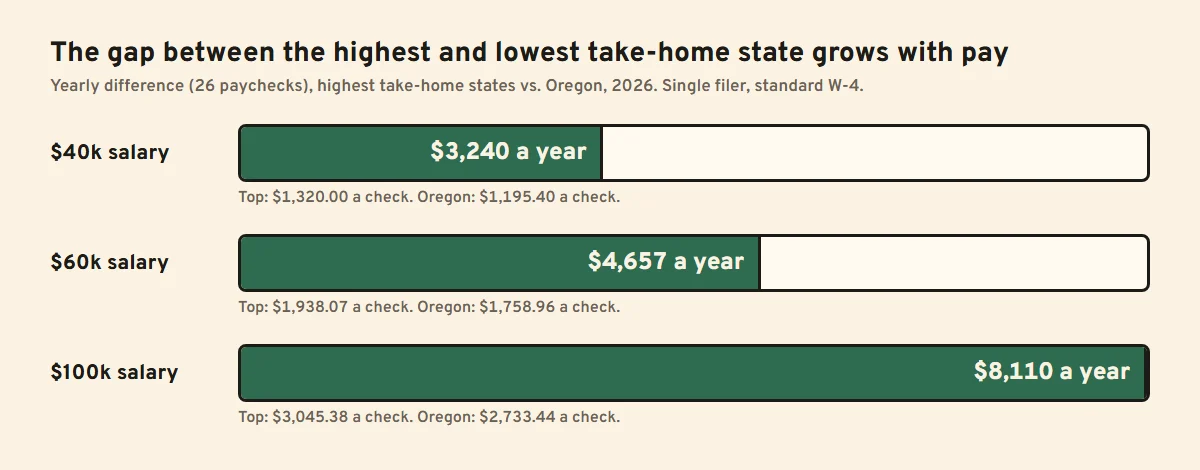
State withholding takes more dollars as pay rises. In 39 of the 41 states that tax wages it also takes a bigger share (Arizona’s default 2.0% and Pennsylvania’s 3.07% stay flat), so the distance between the top and bottom states widens. Per paycheck, the gap is:
- $124.60 at $40,000 ($1,320.00 vs. $1,195.40)
- $179.11 at $60,000 ($1,938.07 vs. $1,758.96)
- $311.94 at $100,000 ($3,045.38 vs. $2,733.44)
At $100,000 that adds up to about $8,110 a year in take-home pay, with nothing else about the job changing.
The State Payroll Premiums That Income-Tax Rankings Miss
A state income tax isn’t the only state line on a pay stub. Sixteen states withhold an employee premium for a state program. Some of them, like Washington and Alaska, have no income tax at all. These come out of the paycheck (some only until a yearly wage cap), so a ranking that counts only income tax overstates take-home pay in those states.
| State | What comes out at $60k (per check) | Total |
|---|---|---|
| Alaska | Alaska unemployment insurance $10.42 | $10.42 |
| California | CA SDI $30.00 | $30.00 |
| Colorado | CO FAMLI premium $10.15 | $10.15 |
| Connecticut | CT Paid Leave $11.54 | $11.54 |
| Delaware | Delaware Paid Leave $9.23 | $9.23 |
| Hawaii | HI TDI $11.54 | $11.54 |
| Maine | Maine Paid Family & Medical Leave $11.54 | $11.54 |
| Massachusetts | MA Paid Family and Medical Leave $10.62 | $10.62 |
| Minnesota | MN Paid Leave $10.15 | $10.15 |
| New Jersey | NJ unemployment and workforce $7.32; NJ disability insurance $4.38; NJ family leave insurance $5.31 | $17.01 |
| New York | NY Paid Family Leave $9.97; NY disability $1.20 | $11.17 |
| Oregon | Oregon statewide transit tax $2.31; Paid Leave Oregon $13.85 | $16.16 |
| Pennsylvania | PA unemployment $1.62 | $1.62 |
| Rhode Island | Rhode Island TDI $25.38 | $25.38 |
| Vermont | Vermont Child Care Contribution $2.54 | $2.54 |
| Washington | WA Paid Family & Medical Leave $18.63; WA Cares Fund $13.38 | $32.01 |
In our data, Washington takes the most in premiums at $60,000 ($32.01 a check across two programs), followed by California’s State Disability Insurance ($30.00). Rates, caps and wage bases differ by state. California’s 1.3% SDI rate comes from the Employment Development Department’s 2026 Employer’s Guide, and Washington’s paid leave premium from the Employment Security Department’s 2026 rate announcement. Each state’s calculator page links to the agency for its own premiums.
What This Data Doesn’t Show
- Your own situation. Married filers, dependents, a 401(k), health premiums or extra withholding all change the numbers. Use the paycheck calculator to compare states with your own salary, or the gross vs. net pay guide for what each line means.
- Local taxes beyond our defaults. City taxes in places like New York City, Philadelphia or Ohio cities, Pennsylvania’s local earned income taxes, and county taxes other than our Maryland (Montgomery) and Indiana (Marion) defaults aren’t included.
- Cost of living. Higher take-home doesn’t mean a cheaper place to live. Housing, sales tax and property tax are outside this study.
- Your year-end tax bill. Withholding is an estimate of tax, not the tax itself.
This page is general information, not tax advice.
Frequently Asked Questions
Which states have the highest payroll taxes?
Federal payroll taxes, 6.2% for Social Security and 1.45% for Medicare, are the same in every state. On top of those, 16 states withhold their own payroll premiums. At $60,000, Washington takes the most ($32.01 a check for paid leave and WA Cares), then California ($30.00 for SDI).
How much federal tax do you pay on $100,000 a year?
For a single filer paid biweekly with a standard 2026 W-4, federal income tax withholding on $100,000 is $506.54 per check, about $13,170 a year. Social Security and Medicare add $294.23 per check. Both are the same in every state.
Which state has the highest take-home pay?
At all three salaries, the highest take-home pay is in the seven states that withhold nothing at the state level. At $40,000 North Dakota ties them at $1,320.00, because it withholds nothing at that pay. At $60,000, Florida, Nevada, New Hampshire, South Dakota, Tennessee, Texas and Wyoming tie at $1,938.07 per biweekly check.
Which state has the lowest take-home pay?
Oregon, at all three salaries we tested. At $60,000 a single filer takes home $1,758.96 per biweekly check.
Can I use this data in my article?
Yes. The data is free to use under a Creative Commons Attribution 4.0 license (CC BY 4.0). Credit “CalcFacts” and link to this page. The CSV has every figure, and our methodology page documents the formulas and test cases behind them.
Run Your Own Numbers
These figures use one standard worker. To see your own paycheck, open the paycheck calculator. It runs your salary through every state at once, or you can pick your state from the table above.