
Gross vs Net Pay: Is Gross Before or After Tax?
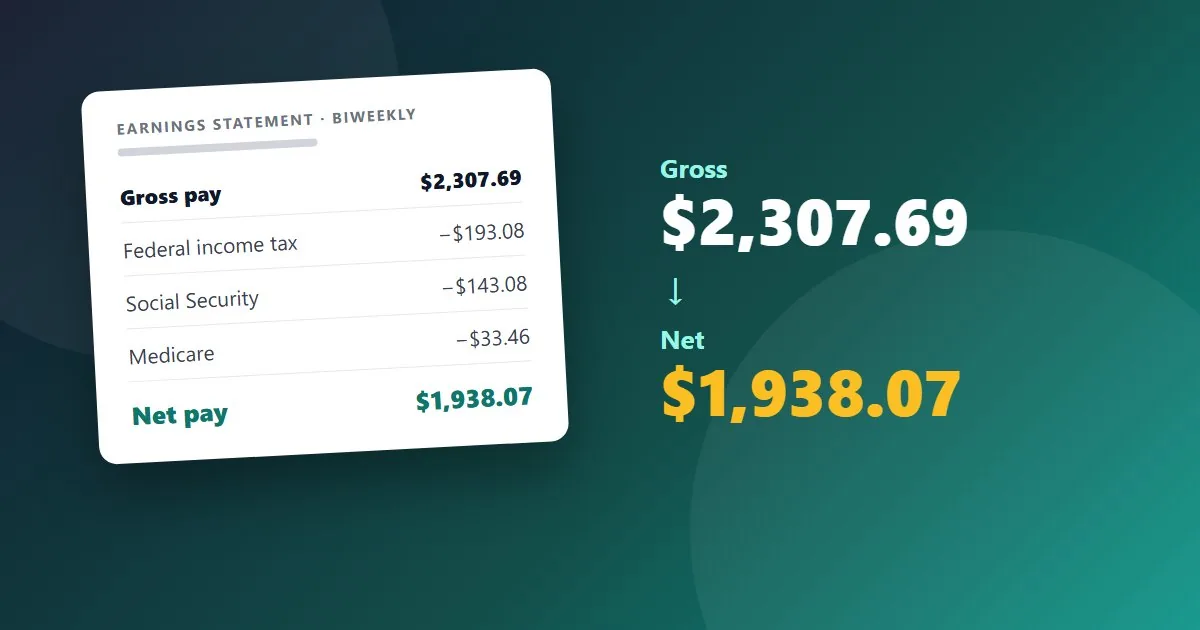
Gross pay is what you earn before anything is taken out. Net pay is what’s left after taxes and deductions: the amount that actually lands in your bank account. So when a job offer says $60,000, that’s gross. If you’re paid every two weeks, each paycheck starts at $2,307.69, and a single filer in Texas takes home about $1,938.07 of it.
This guide explains what comes out of gross pay, how to work out net pay, why some pre-tax deductions lower your taxes more than others, and why the same salary nets a different amount from state to state. To run your own numbers, use the paycheck calculator.
Last updated November 2, 2026 · Tax review: pending sign-off by a licensed tax professional (EA/CPA)
Key Takeaways
- Gross pay is before taxes and deductions; net pay (take-home pay) is after.
- On a $60,000 salary paid biweekly, a single filer in Texas keeps $1,938.07 of each $2,307.69 paycheck, about 84%.
- A traditional 401(k) contribution lowers federal income tax but not Social Security or Medicare; a section 125 health premium lowers all three.
- Lenders use gross income for debt-to-income ratios; budgets work best on net pay.
In this guide
- Is Gross Before or After Tax?
- Gross Pay vs Net Pay at a Glance
- What Comes Out of Gross Pay
- How to Calculate Net Pay From Gross
- Pre-Tax Deductions Don’t All Lower the Same Taxes
- Why Your W-2 Wages Don’t Match Your Gross Pay
- Same Gross, Different Net: State Examples
- When to Use Gross vs Net
- Frequently Asked Questions
- The Bottom Line
Is Gross Before or After Tax?
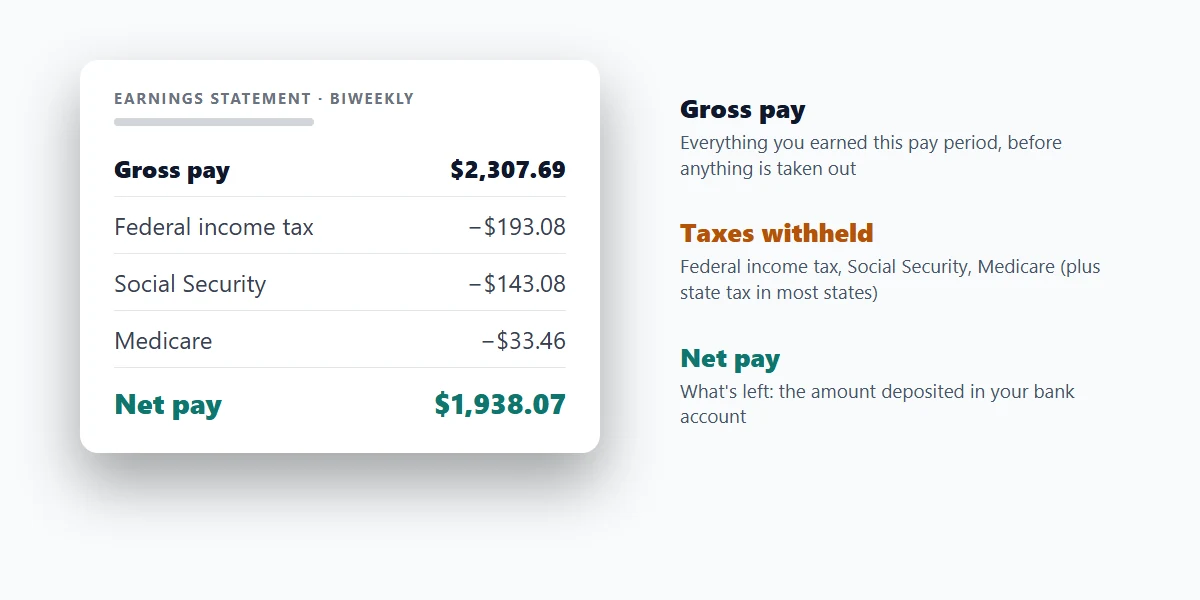
Gross is always before tax. Gross pay is your total earnings for a pay period (salary, hourly wages, overtime, bonuses, commissions and tips) before any taxes or deductions come out. Net pay is after: it’s gross pay minus taxes withheld and any other deductions, such as retirement contributions and health insurance premiums.
The same rule holds outside of paychecks. “Gross” means the starting total before subtractions and “net” means what’s left, whether you’re talking about profit, sales or even shipping weight. This guide sticks to pay.
Gross Pay vs Net Pay at a Glance
| Detail | Gross pay | Net pay |
|---|---|---|
| What it is | Total earnings before taxes and deductions | Earnings after taxes and deductions |
| Also called | Gross income, gross wages | Take-home pay (sometimes called net income) |
| Where you see it | Job offer, top of your pay stub | Bottom of your pay stub, bank deposit |
| Taxes taken out yet? | No | Yes: federal, Social Security, Medicare, and state if any |
| Typically used for | Salary offers, loan and rental applications | Budgeting and day-to-day spending |
For hourly workers, gross pay is your rate times the hours you worked. At $20 an hour for 40 hours a week, a two-week paycheck is $1,600 gross. A single filer in Texas with a standard 2026 W-4 takes home about $1,369.45 of it. Overtime pay adds to gross pay too; the overtime calculator shows what that does to a paycheck.
What Comes Out of Gross Pay
Three taxes come out of almost every paycheck: federal income tax, Social Security and Medicare. On many pay stubs they appear as codes such as FITW, OASDI and MED; our guide to pay stub tax codes decodes each one. State income tax comes out in most states, a handful of states add payroll programs such as paid leave or disability insurance, and voluntary deductions come out on top of that.
- Federal income tax. Your employer figures it from your Form W-4 using the IRS’s 2026 withholding tables (IRS Publication 15-T). The rates on your yearly income are the federal brackets; see the 2027 tax brackets for next year’s.
- Social Security. The employee rate is 6.2%, on wages up to $184,500 in 2026 (IRS Topic 751). Social Security and Medicare together are FICA; the FICA tax guide has the rates by year and the wage cap.
- Medicare. The employee rate is 1.45% with no wage cap. Employers also withhold an extra 0.9% Additional Medicare Tax on wages above $200,000 in a calendar year, regardless of filing status (IRS Topic 751).
- State and local income tax. Most states tax wages, and some cities and counties add their own tax. Each state has its own paycheck calculator page with that state’s rules.
- State payroll programs. Some states run paid leave or disability programs funded by a payroll deduction, such as California’s SDI and New York’s Paid Family Leave.
- Pre-tax deductions. Traditional 401(k) contributions, section 125 health premiums and HSA contributions made through a cafeteria plan come out before some or all taxes are figured.
- After-tax deductions. Roth 401(k) contributions, wage garnishments and union dues come out after taxes.
Here’s the full path from gross to net for a $60,000 salary paid every two weeks, for a single filer with a standard 2026 W-4 in Texas, which has no state income tax:
| Per paycheck | Amount |
|---|---|
| Gross pay | $2,307.69 |
| Federal income tax | −$193.08 |
| Social Security (6.2%) | −$143.08 |
| Medicare (1.45%) | −$33.46 |
| Net pay | $1,938.07 |
That’s $369.62 withheld from each paycheck, leaving 84% of gross. Over 26 paychecks, net pay comes to about $50,390 for the year. These figures come from the same engine that runs our calculators; how we calculate take-home pay lists the tables and sources behind it.
How to Calculate Net Pay From Gross
You can work out net pay in four steps:
- Find gross pay per paycheck. Divide your yearly salary by the number of pay periods (52 for weekly, 26 for biweekly, 24 for semimonthly, 12 for monthly), or multiply your hourly rate by the hours you worked.
- Subtract pre-tax deductions for each tax they apply to. This is where it gets tricky, as the next section shows.
- Subtract taxes: federal income tax from Publication 15-T, Social Security at 6.2%, Medicare at 1.45%, and state and local tax where they apply.
- Subtract after-tax deductions. What’s left is net pay.
Federal income tax is the hard part to do by hand, because it depends on your filing status, the W-4 steps you filled in and the IRS percentage tables. The paycheck calculator handles all four steps for any state.
Pre-Tax Deductions Don’t All Lower the Same Taxes
A pre-tax deduction doesn’t lower your net pay dollar for dollar, and different deductions skip different taxes. That’s why two coworkers with the same salary and the same total deductions can take home different amounts.
The IRS treats two common pre-tax deductions differently:
- Traditional (pre-tax) 401(k) contributions are generally exempt from federal income tax withholding, but Social Security and Medicare still apply to them (IRS Publication 15, “Retirement and pension plans” table).
- Section 125 (cafeteria plan) health premiums: accident and health benefits are generally exempt from federal income tax withholding, Social Security and Medicare alike (IRS Publication 15-B, Table 2-1).
| Per paycheck ($60,000, Texas) | No deductions | With 5% 401(k) + $100 health premium |
|---|---|---|
| Federal income tax | $193.08 | $167.23 |
| Social Security | $143.08 | $136.88 |
| Medicare | $33.46 | $32.01 |
| 401(k) contribution (5%) | — | $115.38 |
| Health premium (section 125) | — | $100.00 |
| Net pay | $1,938.07 | $1,756.19 |
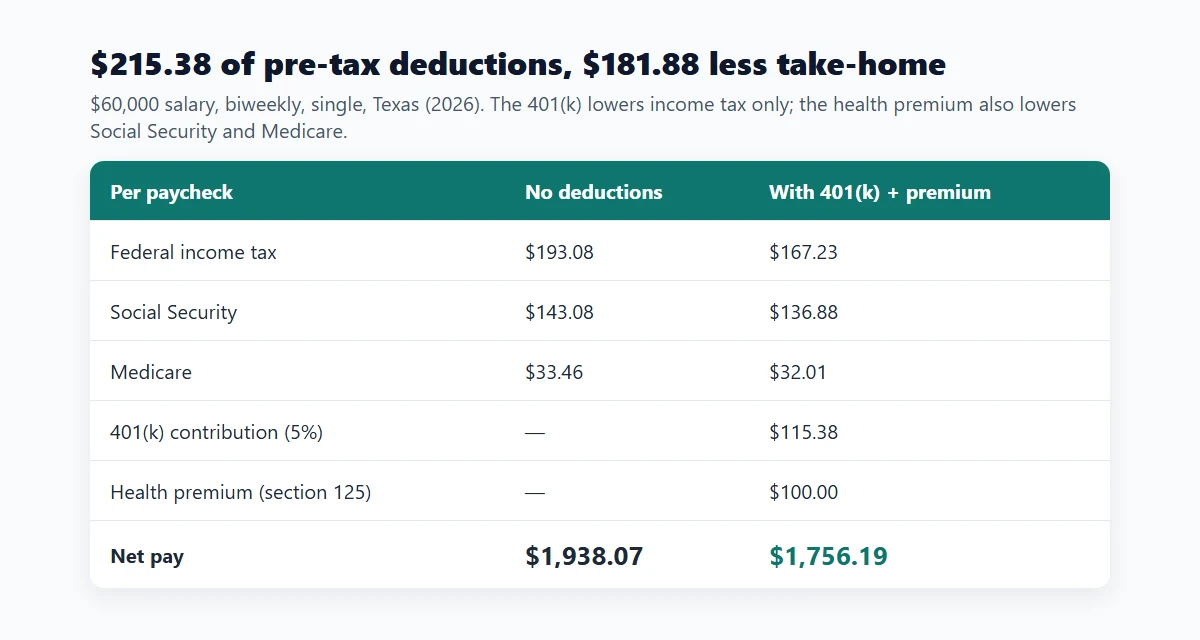
Take the same $60,000 Texas paycheck and add a 5% 401(k) contribution ($115.38) and a $100 health premium through a cafeteria plan. Federal income tax drops from $193.08 to $167.23, because both deductions come out before it’s figured. Social Security drops from $143.08 to $136.88 and Medicare from $33.46 to $32.01, but only the $100 premium causes those drops; the 401(k) money is still taxed for both. Net pay falls from $1,938.07 to $1,756.19. So $215.38 of deductions cost $181.88 in take-home pay, because $33.50 of the difference is tax you no longer pay.
Why Your W-2 Wages Don’t Match Your Gross Pay
Your W-2 can show three different wage figures, and they won’t always match the gross pay on your pay stubs. Box 1 leaves out more pre-tax deductions than Boxes 3 and 5, and Box 3 also stops at the Social Security wage base ($184,500 in 2026).
Box 1 (wages, tips, other compensation) leaves out elective deferrals such as employee contributions to a 401(k) or 403(b) plan. Box 3 (Social Security wages) and Box 5 (Medicare wages) include those deferrals (IRS General Instructions for Forms W-2 and W-3, 2026). Health premiums paid through a cafeteria plan usually stay out of all three, because they’re exempt from income tax withholding, Social Security and Medicare (IRS Publication 15-B, Table 2-1). So someone earning $60,000 who put $3,000 into a 401(k) would typically see $57,000 in Box 1 and $60,000 in Boxes 3 and 5, before any health premiums.
“Gross income” on a tax return is a different idea again. The IRS describes it as your total income from all sources, including wages, interest, dividends, capital gains, business income and retirement income. Adjusted gross income (AGI) is that total minus certain adjustments (IRS, Definition of Adjusted Gross Income). Your pay stub’s gross pay is only the wage part, from one employer.
Same Gross, Different Net: State Examples
Where you live changes net pay even when gross pay is identical. State income tax rates, state withholding rules and state payroll programs all differ. Here’s a $60,000 salary paid every two weeks, for a single filer with a standard federal W-4 and default state withholding settings, in seven states:
| State | Take-home per paycheck |
|---|---|
| Texas (and Florida) | $1,938.07 |
| Pennsylvania | $1,865.60 |
| California | $1,838.71 |
| Utah | $1,835.07 |
| Illinois | $1,829.41 |
| New York | $1,824.00 |
| Minnesota | $1,815.73 |
The gap between Texas and Minnesota is $122.34 per paycheck, about $3,180 over a year. These figures leave out city taxes such as New York City’s and Pennsylvania’s local earned income taxes, which lower net pay further; the New York and Pennsylvania calculators let you add them.
When to Use Gross vs Net
Use gross pay when someone asks what you earn, and net pay when you plan what you can spend.
- Loans and rental applications. Lenders compare your debts with your gross income, and many landlords also ask for gross income. The Consumer Financial Protection Bureau defines your debt-to-income ratio as your total monthly debt payments divided by your gross monthly income (CFPB).
- Budgeting. Your bills get paid from net pay, so a monthly budget built on net pay matches the money you actually have.
- Savings goals. Some budgeting advice works from gross pay and some from take-home pay. A percentage of gross sets a higher target; a percentage of net is easier to plan around. Either way, traditional 401(k) contributions have already come out before your net pay. Our guide to living paycheck to paycheck shows how long different savings rates take to build an emergency fund.
- Job offers. Salaries are quoted gross. When you compare offers in different states, or with different benefits, compare the net pay too.
Frequently Asked Questions
Is net pay before or after taxes?
After. Net pay is what’s left of your gross pay once taxes and other deductions are taken out. It’s the amount deposited into your bank account.
What is my gross income if I make $1,000 a week?
Your gross pay is $1,000 a week, or $52,000 a year before taxes. A single filer in Texas with a standard 2026 W-4 takes home about $845.42 a week: $78.08 goes to federal income tax, $62.00 to Social Security and $14.50 to Medicare.
What is $30 an hour after taxes?
At 40 hours a week, $30 an hour is $2,400 gross every two weeks. A single filer in Texas takes home about $2,012.25 per paycheck, or $52,318.50 a year. State income tax lowers that in most other states; the state paycheck calculators show the difference.
What is my net pay if my gross is $30,000?
A $30,000 salary paid every two weeks is $1,153.85 gross per paycheck. A single filer in Texas takes home about $1,010.96, or about $26,285 a year, after $54.62 federal income tax, $71.54 Social Security and $16.73 Medicare.
Is overtime pay part of gross pay?
Yes. Overtime, bonuses and commissions are all part of gross pay, and the same payroll taxes apply to them. Our guide to how overtime is taxed explains why a paycheck with overtime can look like it had more tax taken out, and what the 2025–2028 federal overtime deduction changes when you file.
The Bottom Line
- Gross pay comes before taxes and deductions; net pay is what’s left after them.
- Federal income tax, Social Security (6.2%) and Medicare (1.45%) come out of nearly every paycheck, and state tax comes out in most states.
- A traditional 401(k) lowers income tax only, while a section 125 health premium lowers Social Security and Medicare too.
- The same gross salary nets different amounts by state: $1,938.07 per paycheck in Texas versus $1,815.73 in Minnesota on $60,000.
Want your own numbers? Pick your state in the paycheck calculator and enter your salary or hourly rate, your W-4 and your deductions.
Sources
- IRS Topic No. 751, Social Security and Medicare Withholding Rates
- IRS Publication 15-T (2026), Federal Income Tax Withholding Methods
- IRS Publication 15 (2026), Employer’s Tax Guide
- IRS Publication 15-B (2026), Employer’s Tax Guide to Fringe Benefits
- IRS General Instructions for Forms W-2 and W-3 (2026)
- IRS, Definition of Adjusted Gross Income
- Consumer Financial Protection Bureau, What is a debt-to-income ratio?