
OASDI Tax on Your Pay Stub: Meaning, 2026 Limit and Codes
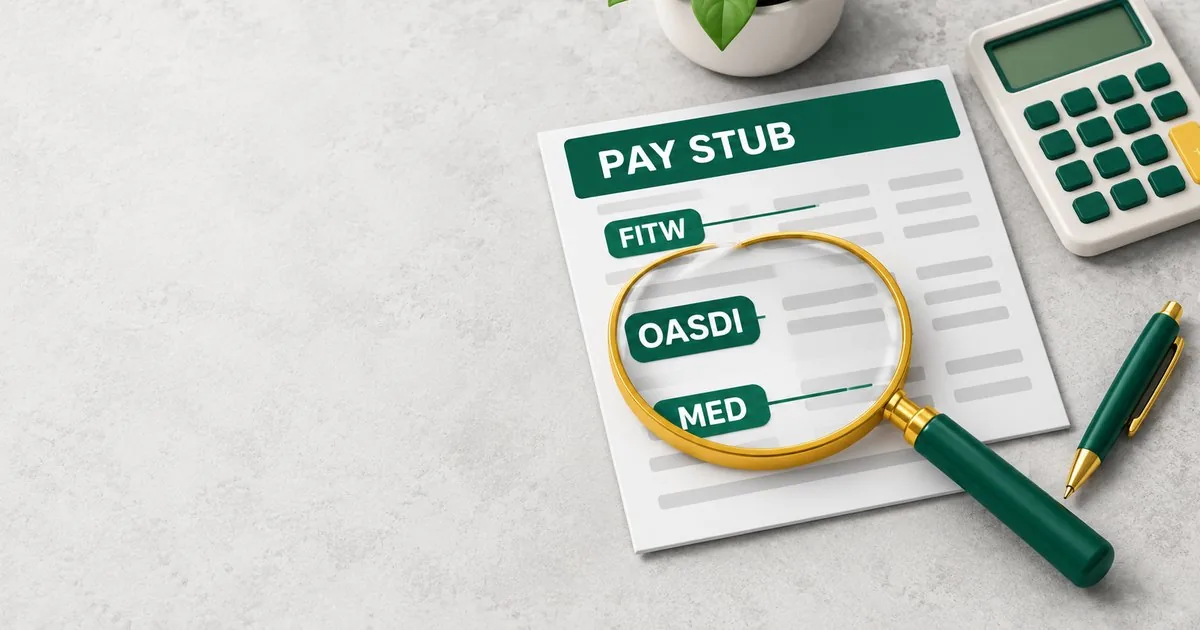
OASDI on your pay stub is the Social Security tax. It stands for Old-Age, Survivors, and Disability Insurance, and in 2026 it takes 6.2% of your wages up to $184,500 for the year. The line next to it, usually labelled MED or MEDI, is Medicare tax at 1.45% with no cap. Together those two are FICA. FITW is something else: federal income tax withholding, the amount your employer estimates from your Form W-4.
This guide decodes every common tax line on a pay stub, shows a real $60,000 paycheck line by line, and answers the questions people ask most: why OASDI is taken, whether you get it back, and why FITW can look high. For your own numbers, use the paycheck calculator.
Last updated November 10, 2026 · Tax review: pending sign-off by a licensed tax professional (EA/CPA)
Key Takeaways
- OASDI is Social Security tax: 6.2% of wages, up to a 2026 wage base of $184,500, so the most any employee owes in 2026 is $11,439 ($11,922.60 in 2027, when the base is $192,300). Your employer pays another 6.2%.
- MED is Medicare tax: 1.45% of all wages, plus 0.9% Additional Medicare Tax that your employer withholds once your pay from that employer passes $200,000 for the year.
- FICA is OASDI and Medicare together: 7.65% for most workers.
- FITW is federal income tax withholding. It depends on your W-4 and is settled when you file: too much becomes a refund, too little a balance due.
- SIT, SDI, PFL and SUI are state lines, and which ones you see depends on your state.
In this guide
- What OASDI Means on a Pay Stub
- Pay Stub Tax Codes at a Glance
- A $60,000 Pay Stub, Line by Line
- OASDI Tax Limit for 2026 and 2027
- OASDI vs Social Security
- MED: Medicare Tax
- FICA: OASDI and Medicare Together
- FITW: Federal Income Tax Withholding
- State and Local Codes
- Frequently Asked Questions
- The Bottom Line
What OASDI Means on a Pay Stub
OASDI is the federal Social Security tax, and on the $60,000 pay stub below it’s the second-biggest deduction after federal income tax. The IRS sets the rate at 6.2% for the employee and 6.2% for the employer, or 12.4% in total, and applies it to wages up to $184,500 in 2026 (IRS Topic No. 751). Some payroll systems label it SS, SOC SEC, FICA-SS, FICA-OASDI or FED OASDI/EE instead; it’s the same tax. “EE” on a stub usually means the employee’s share (“ER” is the employer’s).
On a $60,000 salary paid every two weeks, OASDI is 6.2% × $2,307.69 = $143.08 per paycheck, or about $3,720 for the year.
Pay Stub Tax Codes at a Glance
| Code on your stub | What it is | 2026 rate | Yearly cap | Can you change it? |
|---|---|---|---|---|
| OASDI, OASDI/EE, SS, FICA-SS | Social Security tax | 6.2% | Wages up to $184,500 | No |
| MED, MEDI, FICA-MED | Medicare tax | 1.45% (+0.9% over $200,000) | None | No |
| FICA | OASDI + Medicare combined | 7.65% | Social Security part only | No |
| FITW, FIT, FED, FWT | Federal income tax withholding | Depends on your W-4 and pay | None | Yes, with a new W-4 |
| SIT, SWT, ST | State income tax withholding | Depends on your state | Varies | Often, with the state’s withholding form |
| SDI, CASDI, DBL | State disability insurance | Set by the state | Varies | No |
| PFL, FLI, PFML | State paid family leave | Set by the state | Varies | Generally no |
| SUI, UC | State unemployment (employee share, in a few states) | Set by the state | Varies | No |
| LIT, LOCAL, EIT, CITY | City, county or school district tax | Set locally | Varies | Sometimes |
The federal rates come from the IRS (Topic 751; Topic 560). Each state line follows that state’s own rules; the state paycheck calculators linked below cite them.
A $60,000 Pay Stub, Line by Line
Take a single filer earning $60,000 a year, paid every two weeks, with a standard 2026 federal W-4 and no pre-tax deductions, working in Texas (no state income tax):
| Line | Amount | How it’s figured |
|---|---|---|
| Gross pay | $2,307.69 | $60,000 ÷ 26 |
| FITW (federal income tax) | −$193.08 | IRS Publication 15-T percentage method |
| OASDI (Social Security) | −$143.08 | 6.2% of $2,307.69 |
| MED (Medicare) | −$33.46 | 1.45% of $2,307.69 |
| Net pay | $1,938.07 |
FICA here is $143.08 + $33.46 = $176.54, 7.65% of gross, to the cent. FITW follows the IRS percentage tables for 2026 (IRS Publication 15-T); the steps are on our methodology page. For what’s left after all of this, see gross vs net pay.
OASDI Tax Limit for 2026 and 2027
The cap is why OASDI stops partway through the year for high earners. Social Security tax applies only to the first $184,500 of wages in 2026 (IRS Topic 751), so the largest amount anyone can owe is 6.2% × $184,500 = $11,439. OASDI stops for the rest of the year once your wages from an employer reach that limit, and starts again in January.
| OASDI tax limit | 2025 | 2026 | 2027 |
|---|---|---|---|
| Wage base | $176,100 | $184,500 | $192,300 |
| Most OASDI an employee owes | $10,918.20 | $11,439 | $11,922.60 |
2025: IRS Publication 926 (2025). 2026: IRS Topic 751. 2027: the “OASDI contribution and benefit base will be $192,300 for remuneration paid in 2027” (Federal Register, 91 FR 67380). The 6.2% rate is the same in all three years.
Take a $250,000 salary paid every two weeks ($9,615.38 per paycheck):
- Paychecks 1–19: OASDI is $596.15 each, and wages reach $182,692.22.
- Paycheck 20: OASDI is $112.08, on the last $1,807.78 below the cap.
- Paychecks 21–26: OASDI is $0. Take-home doesn’t rise by the full $596.15, though: wages pass $200,000 on paycheck 21, so the 0.9% Additional Medicare Tax starts there ($17.31 on paycheck 21, then $86.54 on each of paychecks 22–26).
Do you get OASDI back?
Not as a refund, usually, but the earnings it’s paid on count toward Social Security: in 2027 you need $1,970 of taxable earnings to be credited with one quarter of coverage, the credits used for retirement, survivor and disability benefits (Federal Register, 91 FR 67380). As a tax, OASDI isn’t an estimate of your income tax, so your return doesn’t compare it with what you owe the way it does for FITW. What it pays for is in the name: Social Security’s old-age, survivors and disability insurance. The exception is working for more than one employer: if your combined wages pass $184,500, each employer withholds on its own wages, and you can claim the excess as a credit on your income tax return. If a single employer withheld too much, that employer should correct it; if it doesn’t, you can file Form 843. Married couples figure any excess separately for each spouse (IRS Topic 608).
Can you remove OASDI from your paycheck?
No, OASDI tax is mandatory for almost all employees. Social Security and Medicare are withheld from wages at fixed rates (IRS Topic 751), and Form W-4 only controls federal income tax withholding (IRS, About Form W-4), so changing it won’t remove them. There are exemptions set by law, such as nonresident alien students in F-1, J-1 or M-1 status, generally in their first five calendar years in the U.S. and doing work their visa allows (IRS), and some state and local government employees who are members of a qualifying public retirement system instead of Social Security. Those government workers usually still pay Medicare tax, so their stubs show MED but no OASDI (IRS, State and local government employees). If you think one applies, ask your payroll department; the FICA tax guide lists the main exemptions.
OASDI vs Social Security
OASDI tax is the Social Security tax. OASDI, Old-Age, Survivors, and Disability Insurance, is the formal name of the Social Security program the tax pays for. Federal notices call the Social Security wage limit the “Old-Age, Survivors, and Disability Insurance (OASDI) contribution and benefit base”; for 2027 it’s $192,300 (Federal Register). The IRS calls the same limit the Social Security wage base: $184,500 for 2026 (IRS Topic 751). Your pay stub may say OASDI, SS or Social Security; the 6.2% is the same.
As the name says, it covers three kinds of benefits: retirement (old age), survivors and disability; the 2027 notice sets amounts for each, such as the earnings test for retirees and the disability earnings limits (Federal Register, above). Social Security is also only part of FICA: FICA adds Medicare tax on top.
MED: Medicare Tax
Medicare tax is 1.45% for the employee and 1.45% for the employer, or 2.9% in total, and unlike OASDI it has no wage cap (IRS Topic 751). On the $60,000 example, it’s $33.46 per paycheck.
Higher earners also pay the Additional Medicare Tax of 0.9%. Your employer starts withholding it in the pay period when your wages from that employer pass $200,000 for the year, whatever your filing status, and doesn’t match it. Your actual threshold depends on filing status: $250,000 married filing jointly, $125,000 married filing separately, and $200,000 for everyone else. You settle the difference on Form 8959 when you file (IRS Topic 560). On a $250,000 salary, your employer withholds an extra 0.9% on the $50,000 above $200,000, or $450 for the year; what you actually owe depends on your filing status.
Why do you pay Medicare tax if you don’t have Medicare? Because it’s a tax on wages, not a premium for coverage you have now. Employers withhold 1.45% of employee wages and pay a matching 1.45% (IRS Topic 751); whether you’re enrolled in Medicare or have other health insurance doesn’t change that.
FICA: OASDI and Medicare Together
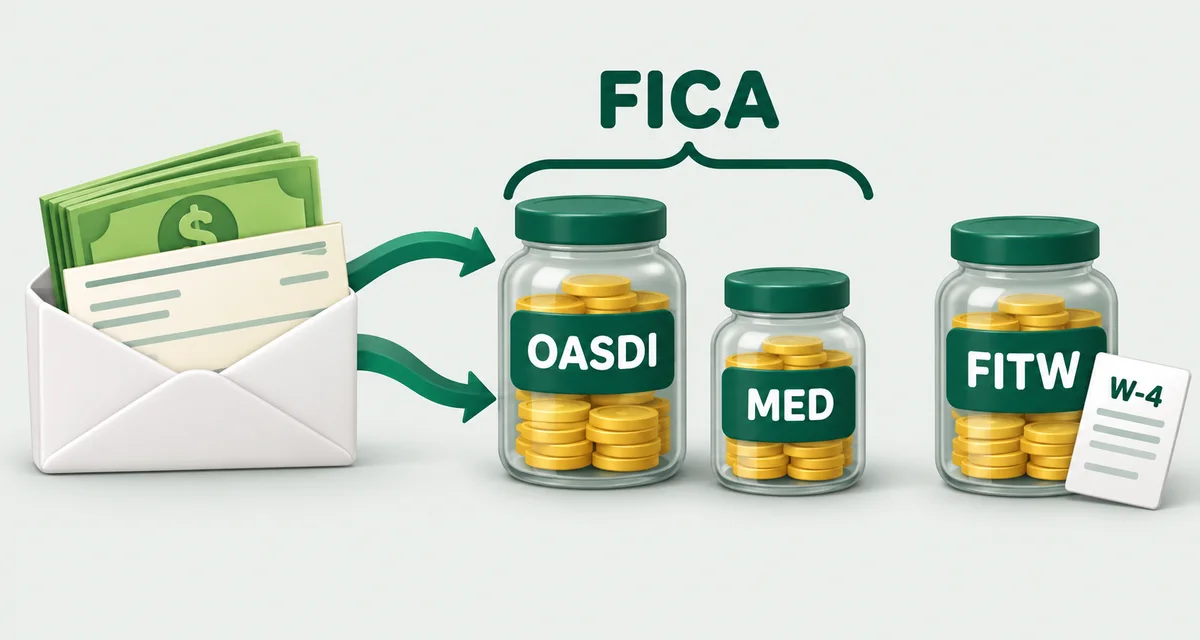
On a pay stub, FICA is simply OASDI plus MED: 6.2% + 1.45% = 7.65% of wages for most employees (IRS Topic 751). Some stubs show one FICA line; others split it into OASDI and MED. Either way, the total on a $60,000 biweekly paycheck is $176.54. Rates by year, what employers pay, the self-employed rate and when FICA comes back are in the FICA tax guide; self-employed people can use the self-employment tax calculator.
FITW: Federal Income Tax Withholding
FITW is the federal income tax your employer takes out of each paycheck, based on what you earn and the information on your Form W-4 (IRS). It’s an estimate of your yearly income tax, paid in installments. When you file your return, the real tax is worked out: if withholding was more than the tax, you get the difference back as a refund; if it was less, you owe the rest. The rates behind that yearly tax are the federal brackets; see the 2027 tax brackets for next year’s.
Why FITW can look high:
- Your W-4 settings. Checking the Step 2 box (two jobs) or entering extra withholding in Step 4(c) raises it.
- A bigger paycheck. For regular pay, withholding is figured as if each paycheck’s pay continued all year, so a paycheck with overtime can be withheld at a higher rate. Bonuses and other supplemental wages follow separate rules, so their withholding can differ from a regular paycheck (IRS Publication 15-T).
- No pre-tax deductions. Traditional 401(k) contributions and pre-tax (section 125) health premiums lower the pay that FITW is figured on.
Can you opt out of FITW? Only by claiming exemption on Form W-4, and only if you had no federal income tax liability in 2025 and expect none in 2026. The exemption lasts one year, so you’d need a new W-4 for 2027 (IRS Form W-4, 2026). To change how much is withheld, give your employer a new W-4. The IRS Tax Withholding Estimator can help you pick the numbers.
State and Local Codes
State lines are where pay stubs differ most. On the same $60,000 biweekly paycheck:
| State | Extra lines on the stub | Net pay |
|---|---|---|
| Texas | None | $1,938.07 |
| Pennsylvania | SIT $70.85, UC $1.62 (plus a local earned income tax, not included) | $1,865.60 |
| California | SIT $69.36, CA SDI $30.00 | $1,838.71 |
| New York | SIT $102.90, PFL $9.97, DBL $1.20 | $1,824.00 |
- SDI (California). State disability insurance, 1.3% of wages in 2026 (California EDD, DE 44).
- PFL and DBL (New York). Paid Family Leave at 0.432% of wages (New York Paid Family Leave, 2026) and disability benefits up to $0.60 a week (New York Workers’ Compensation Board).
- UC (Pennsylvania). The employee share of unemployment insurance, 0.07% of wages (Pennsylvania Department of Labor & Industry).
- Other states. New Jersey, Washington, Rhode Island and others add their own lines; each state calculator lists them with sources.
Frequently Asked Questions
Why am I paying OASDI tax?
Because federal law requires Social Security tax on wages: your employer withholds 6.2% of your pay, up to $184,500 in 2026, and pays a matching 6.2% itself (IRS Topic 751).
Is OASDI the same as federal income tax?
No. OASDI is Social Security tax at a flat 6.2%. Federal income tax is the FITW line, and it depends on your W-4, your pay and your deductions.
Is OASDI tax mandatory?
For almost all employees, yes. It’s withheld at a fixed 6.2%, and a new W-4 can’t change it. A few groups are exempt by law, such as some nonresident alien students in F-1, J-1 or M-1 status and some state and local government employees covered by a public retirement system (see above and who is exempt from FICA).
What is the OASDI tax limit for 2026?
$184,500 of wages, so at most $11,439 of OASDI tax for an employee (IRS Topic 751). For 2027 the limit rises to $192,300, at most $11,922.60 (Federal Register).
Do I get my FITW back?
Only the part that’s more than your actual federal income tax for the year. FITW is a prepayment, so your return compares it with the tax you owe and refunds any overpayment. If withholding fell short, you pay the rest.
How much FITW should be withheld?
Ideally, close to your federal income tax for the year. For a single filer earning $60,000 with a standard 2026 W-4, it’s $193.08 every two weeks. The paycheck calculator shows the amount for your W-4, and the IRS Tax Withholding Estimator compares it with your expected tax.
What does Fed OASDI/EE mean?
Federal OASDI, employee share: the 6.2% Social Security tax withheld from your pay. On $60,000 a year paid every two weeks, that’s $143.08 a paycheck, about $3,720 for the year. Your employer pays the same amount, but it isn’t taken from your pay. For take-home pay at other salaries, use the paycheck calculator.
The Bottom Line
- OASDI is Social Security tax: 6.2% of wages up to $184,500 in 2026 ($192,300 in 2027), at most $11,439.
- MED is Medicare tax: 1.45% with no cap, plus 0.9% withheld once your wages from one employer pass $200,000.
- FICA is the two together, 7.65% for most workers, and most employees can’t opt out of it.
- FITW is federal income tax withholding: set by your W-4 and settled when you file.
- State codes such as SIT, SDI and PFL depend on where you work.
To see every line of your own paycheck, pick your state in the paycheck calculator and enter your salary or hourly rate and your W-4.
Sources
- IRS Topic No. 751, Social Security and Medicare Withholding Rates
- IRS Topic No. 560, Additional Medicare Tax
- IRS Topic No. 608, Excess Social Security and RRTA Tax Withheld
- IRS Publication 926 (2025), Household Employer’s Tax Guide
- Federal Register, 91 FR 67380: Cost-of-Living Increase and Other Determinations for 2027
- IRS, Tax Withholding
- IRS, Tax Withholding Estimator
- IRS Form W-4 (2026), Employee’s Withholding Certificate
- IRS, About Form W-4
- IRS, State and Local Government Employees: Social Security and Medicare Coverage
- IRS, Foreign Student Liability for Social Security and Medicare Taxes
- IRS Publication 15-T (2026), Federal Income Tax Withholding Methods
- California EDD, DE 44 California Employer’s Guide (2026)
- New York State Paid Family Leave, 2026 updates
- New York Workers’ Compensation Board, Disability Benefits for Employees
- Pennsylvania Department of Labor & Industry, UC Employee Withholding