
FICA Tax 2026: Rates, Wage Base and How It's Calculated
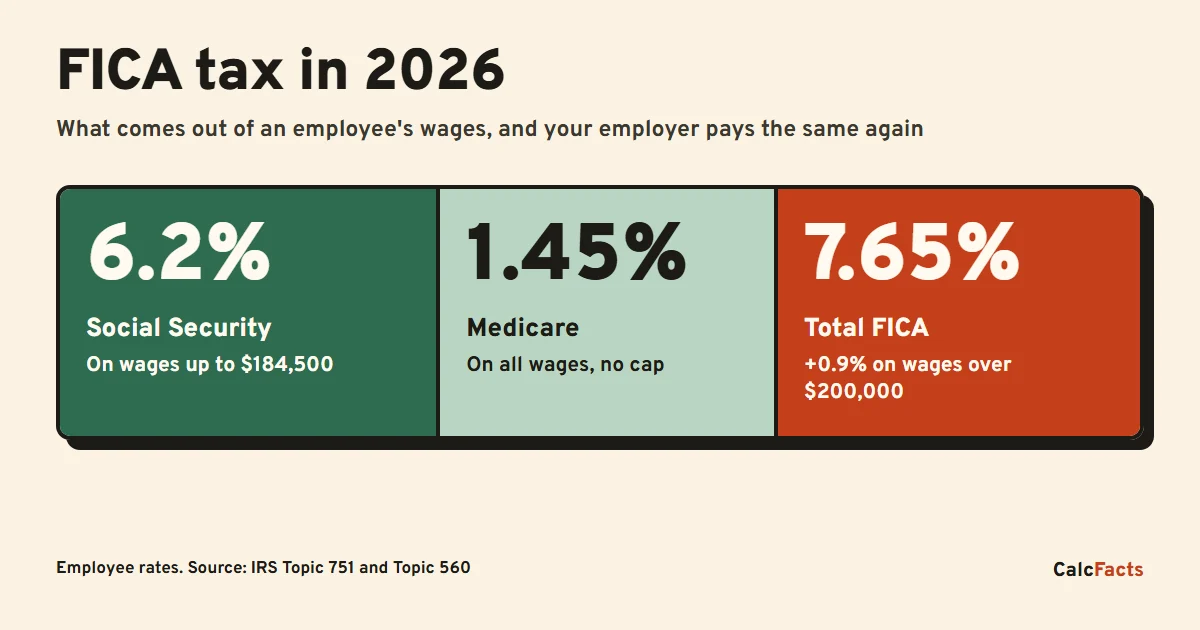
FICA tax is the Social Security and Medicare tax taken out of your wages. In 2026 it’s 7.65% for most employees: 6.2% for Social Security on wages up to $184,500, plus 1.45% for Medicare on all wages. Your employer pays a matching 7.65% on top of your pay, and once your wages from one employer pass $200,000 for the year, another 0.9% of Medicare tax is withheld that the employer doesn’t match (IRS Topic No. 751).
On a $60,000 salary that’s $3,720 of Social Security tax and $870 of Medicare tax, $4,590 for the year. This guide covers the rates for 2025, 2026 and 2027, the wage cap, what employers and the self-employed pay, who is exempt, and when you can get FICA back. To see FICA on your own paycheck, use the paycheck calculator.
Last updated November 10, 2026 · Tax review: pending sign-off by a licensed tax professional (EA/CPA)
Key Takeaways
- FICA = Social Security (6.2%) + Medicare (1.45%) = 7.65% of wages, withheld from each paycheck. Your employer pays the same 7.65% again.
- Social Security tax stops at the wage base: $184,500 in 2026 ($176,100 in 2025, $192,300 in 2027), so the most you owe in 2026 is $11,439.
- Medicare has no cap. An extra 0.9% Additional Medicare Tax is withheld on wages over $200,000, with no employer match.
- Self-employed people pay both halves as self-employment tax: 15.3% on net earnings, with the 12.4% Social Security part capped at the same wage base.
- FICA isn’t refunded at tax time like income tax withholding. The exceptions are over-withholding: Social Security from two jobs whose wages together pass the cap, or Additional Medicare Tax withheld beyond what you owe.
What Is FICA Tax?
FICA stands for the Federal Insurance Contributions Act, the law behind the payroll taxes that fund Social Security and Medicare. It has two parts, and many pay stubs show them on separate lines:
- Social Security tax, often labelled OASDI (Old-Age, Survivors, and Disability Insurance)
- Medicare tax, often labelled MED or MEDI
Some stubs show “FICA EE”, which means the employee’s share. For what OASDI and the other abbreviations mean, see our guide to OASDI tax on your pay stub.
FICA is separate from federal income tax. Income tax withholding depends on your Form W-4 and is settled when you file your return; FICA is a flat percentage of wages that your W-4 doesn’t change (IRS, About Form W-4).
FICA Tax Rates for 2026, 2025 and 2027
The percentages are set by law and didn’t change from 2025 to 2026; only the Social Security wage base changed, as it’s adjusted for wage growth.
| Rate or limit | 2025 | 2026 | 2027 |
|---|---|---|---|
| Social Security, each side | 6.2% | 6.2% | 6.2% |
| Wage base | $176,100 | $184,500 | $192,300 |
| Max Social Security tax | $10,918.20 | $11,439 | $11,922.60 |
| Medicare, each side | 1.45% | 1.45% | 1.45% |
| Additional Medicare | 0.9% | 0.9% | 0.9% |
| Employee total | 7.65% | 7.65% | 7.65% |
“Each side” means the employee and the employer each pay that rate. Additional Medicare is employee-only: it’s withheld on wages over $200,000, and the threshold you actually owe it on depends on filing status. The maximum is for one employee’s Social Security tax.
2025: IRS Publication 926 (2025). 2026: IRS Topic 751 and Topic 560. 2027 wage base: Federal Register, 91 FR 67380 (October 26, 2026). The rates for 2027 assume no change in law.
Medicare Tax Rate, Including the 0.9% Additional Medicare Tax
The Medicare tax rate is 1.45% of your wages, withheld from your pay, and your employer pays another 1.45%, for 2.9% in total. There’s no wage base, so it never stops during the year (IRS Topic 751).
On top of that sits the 0.9% Additional Medicare Tax, which only employees pay. Withholding is mechanical: from the pay period in which one employer has paid you more than $200,000 for the year, that employer withholds the extra 0.9%, without checking your filing status, and doesn’t add an employer share. The amount you really owe is worked out on your return from your filing status (IRS Topic 560):
| Filing status | Additional Medicare Tax applies to wages over |
|---|---|
| Married filing jointly | $250,000 |
| Married filing separately | $125,000 |
| Single, head of household, qualifying surviving spouse | $200,000 |
So withholding and the final bill can differ in both directions. A married couple with combined wages of $260,000, each earning under $200,000, has nothing withheld but owes 0.9% × $10,000 = $90. If instead one spouse earns $230,000 and the other nothing, the employer withholds $270, but the couple is under $250,000 and owes none, so the $270 is credited on their return. A single filer earning $260,000 from one job has $540 withheld, which matches what’s owed. The tax also applies to self-employment income above the same thresholds.
Who pays the 3.8% tax? That’s the net investment income tax, a different tax on investment income such as capital gains, not on wages. It applies to the smaller of your net investment income or the amount your modified AGI exceeds $200,000 (single or head of household), $250,000 (married filing jointly or qualifying surviving spouse) or $125,000 (married filing separately) (IRS Topic 559).
How to Calculate FICA Tax
- Start with wages subject to FICA. That’s usually your gross pay. Benefits you pay for pre-tax through a cafeteria plan, such as health insurance premiums, are in most cases not subject to Social Security and Medicare tax (IRS Publication 15-B). Traditional 401(k) contributions are still subject to them (IRS Topic 424).
- Social Security: multiply by 6.2%, but stop once your year’s wages from that employer reach the wage base ($184,500 in 2026).
- Medicare: multiply all wages by 1.45%.
- Additional Medicare: your employer withholds 0.9% of your wages from that employer above $200,000 for the year; what you owe depends on your filing status, as above.
- Add them up. That’s your share; your employer adds the 6.2% and 1.45% again.
Example: on a $60,000 salary, Social Security is 6.2% × $60,000 = $3,720 and Medicare is 1.45% × $60,000 = $870, so FICA is $4,590, or 7.65%. Paid every two weeks, that’s about $176.54 a paycheck.
FICA Tax at Common Salaries
| Salary (one employer, 2026) | Social Security | Medicare | Additional Medicare | Total employee FICA | Share of salary |
|---|---|---|---|---|---|
| $30,000 | $1,860 | $435 | $0 | $2,295 | 7.65% |
| $50,000 | $3,100 | $725 | $0 | $3,825 | 7.65% |
| $75,000 | $4,650 | $1,087.50 | $0 | $5,737.50 | 7.65% |
| $100,000 | $6,200 | $1,450 | $0 | $7,650 | 7.65% |
| $150,000 | $9,300 | $2,175 | $0 | $11,475 | 7.65% |
| $184,500 | $11,439 | $2,675.25 | $0 | $14,114.25 | 7.65% |
| $250,000 | $11,439 | $3,625 | $450 | $15,514 | 6.21% |
| $400,000 | $11,439 | $5,800 | $1,800 | $19,039 | 4.76% |
Calculated with the CalcFacts FICA engine from IRS Topics 751 and 560. Additional Medicare shown as withheld by one employer.
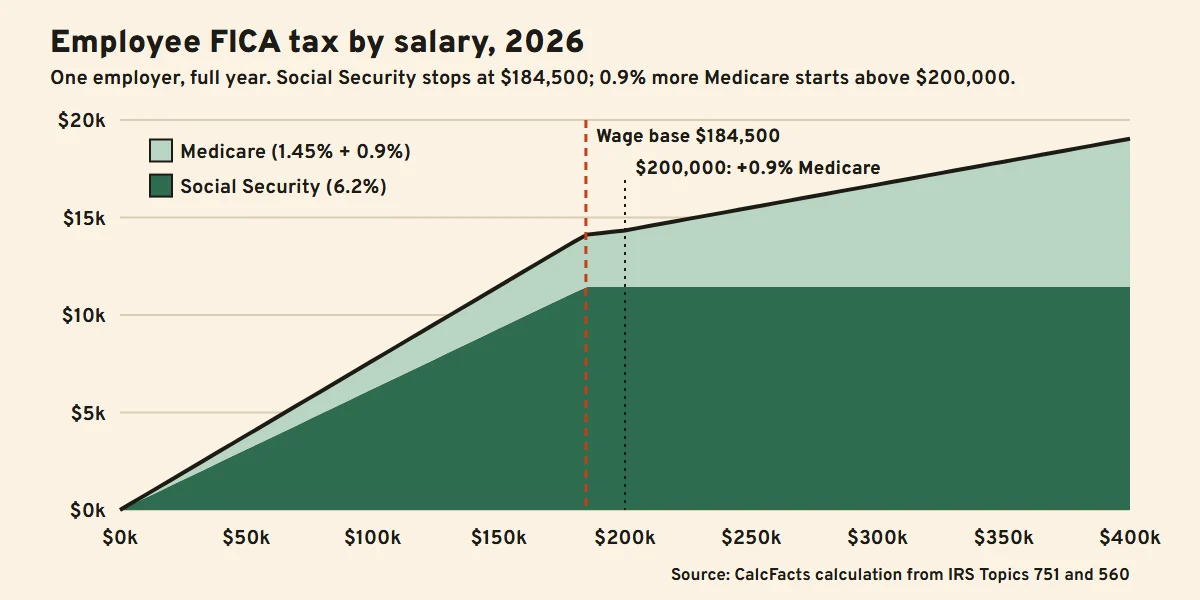
Because Social Security stops at the cap, FICA takes a smaller share of pay above $184,500 even though Medicare keeps going.
The Social Security Wage Base and Maximum FICA
The wage base is the most wages Social Security tax applies to in a year: $184,500 in 2026 (IRS Topic 751). Once your wages from an employer reach it, that employer stops withholding Social Security tax for the rest of the year, so later paychecks get bigger. The most an employee pays in 2026 is 6.2% × $184,500 = $11,439, and it rises to $11,922.60 in 2027, when the base is $192,300.
There’s no maximum for Medicare tax, so there’s no single “maximum FICA” amount. At $250,000 of wages, total employee FICA is $15,514.
What Employers Pay
Employers match the employee’s 6.2% Social Security tax (up to the same wage base) and 1.45% Medicare tax, but not the 0.9% Additional Medicare Tax (IRS Topic 751). On a $60,000 salary the employer pays another $4,590, so total FICA on that job is $9,180. At $250,000 the employee pays $15,514 and the employer $15,064. The employer’s share doesn’t come out of your paycheck, so it doesn’t reduce your net pay; some pay stubs list it for information only.
FICA for the Self-Employed
If you work for yourself, there’s no employer to pay half, so you pay both halves as self-employment tax: 15.3%, made up of 12.4% for Social Security and 2.9% for Medicare, once your net earnings from self-employment are $400 or more. The 12.4% part applies only to the first $184,500 of your combined wages, tips and net earnings in 2026; the 2.9% part applies to all net earnings, and the 0.9% Additional Medicare Tax applies above the thresholds. SE tax is figured on Schedule SE. You can deduct the employer-equivalent half of it when figuring your adjusted gross income (IRS, Self-Employment Tax). The self-employment tax calculator works it out line by line from Schedule SE.
Who Is Exempt From FICA?
Most employees pay FICA. The exemptions are set by law and each has conditions:
- Students working for their school. FICA doesn’t apply to work done by students employed by the school, college or university where they’re pursuing a course of study (IRS, Student exception to FICA tax).
- Some international students. Nonresident alien students in F-1, J-1 or M-1 status, generally for their first five calendar years in the U.S., are exempt on wages for work their status allows. Spouses and children in F-2, J-2 or M-2 status aren’t (IRS, Foreign student liability for Social Security and Medicare taxes).
- Some state and local government employees. Workers who are members of a qualifying public retirement system, and aren’t covered by a Section 218 agreement, can be outside Social Security. Those hired or rehired after March 31, 1986 are still covered for Medicare unless a specific exclusion applies (IRS, State and local government employees).
A few other exemptions exist, each with its own conditions; if you think one applies, ask your employer or check with the IRS.
Can You Get FICA Back?
Usually not. FICA isn’t an estimate of a bigger tax the way income tax withholding is, so your return doesn’t usually refund it. The exceptions are over-withholding:
- Two or more employers. Each employer withholds 6.2% up to the wage base on its own, so if your combined wages pass $184,500, you can overpay. You may be able to claim the excess as a credit on your income tax return; on a joint return, each spouse figures it separately (IRS Topic 608). With $120,000 from one job and $100,000 from another in 2026, $13,640 is withheld against a maximum of $11,439, so $2,201 comes back.
- One employer withheld too much. Your employer should fix it. If it doesn’t, you can ask the IRS for a refund on Form 843 (IRS Topic 608).
- Additional Medicare Tax withheld beyond what you owe. It’s squared up on Form 8959: withheld Additional Medicare Tax is credited against the total tax on your return (IRS Topic 560; IRS, Questions and answers for the Additional Medicare Tax). In the example above, the couple with one $230,000 earner gets the $270 back.
The regular 1.45% Medicare tax has no cap, so it can’t be over-withheld that way.
FICA vs Federal Income Tax
| FICA | Federal income tax | |
|---|---|---|
| What it funds | Social Security and Medicare | General federal budget |
| Rate | Flat 7.65% (plus 0.9% over $200,000) | 10% to 37% brackets on taxable income |
| Set by | Law; same rates for all covered employees | Your income, filing status and deductions |
| Changed by Form W-4? | No | Yes |
| Settled on your tax return? | Only Additional Medicare Tax and excess Social Security | Yes, refund or balance due |
For the income tax side, see the 2027 federal tax brackets and how both come out of your pay in gross vs net pay. States can add their own income tax; nine have none on wages, listed in our guide to states with no income tax. FICA is the same in every state.
Frequently Asked Questions
What is the FICA rate for 2026?
7.65% for employees: 6.2% Social Security on wages up to $184,500 plus 1.45% Medicare on all wages, and another 0.9% on wages over $200,000. Employers pay 7.65% too.
How much is FICA tax on my paycheck?
7.65% of each paycheck’s FICA wages until you reach the Social Security wage base, then 1.45% (plus 0.9% once one employer has paid you over $200,000). On a $45,000 salary paid every two weeks, that’s about $132.40 a paycheck. Our pay stub tax codes guide walks through a full $60,000 stub.
Does everyone have to pay FICA taxes?
Almost all employees do. Exceptions include students working for their own school some nonresident alien students in F-1, J-1 or M-1 status, and some state and local government employees in a public retirement system (from Social Security; most still pay Medicare).
Is FICA the same as federal income tax?
No. FICA funds Social Security and Medicare at fixed rates; federal income tax depends on your income and Form W-4, and you settle it when you file your return.
Why do I have to pay Medicare tax?
The law applies it to wages, whether or not you’re enrolled in Medicare today; it isn’t tied to your own coverage. Employees and employers each pay 1.45% (IRS Topic 751). Social Security works the same way, and the benefits it pays can be partly taxable later, depending on your income (IRS Publication 915); see the taxable Social Security calculator.
The Bottom Line
- FICA is 7.65% of wages for employees in 2026, with an employer match.
- Social Security tax stops at $184,500 ($192,300 in 2027); Medicare doesn’t stop, and 0.9% more applies over $200,000.
- The self-employed pay 15.3% on net earnings, with the Social Security part capped at the wage base.
- You get FICA back on your return mainly when too much Social Security was withheld (usually from two jobs) or when Additional Medicare Tax withheld is more than you owe.
To see FICA alongside federal and state tax on your own pay, use the paycheck calculator.
About this guide: about us · editorial policy · how we calculate · contact
This guide is for general education and is not tax advice. Sources were reviewed on November 10, 2026. For decisions about your own taxes, consult a qualified tax professional.
Sources
- IRS Topic No. 751, Social Security and Medicare withholding rates
- IRS Topic No. 560, Additional Medicare tax
- IRS Topic No. 608, Excess Social Security and RRTA tax withheld
- IRS, Questions and answers for the Additional Medicare Tax
- IRS Topic No. 559, Net investment income tax
- IRS, State and local government employees: Social Security and Medicare coverage
- IRS, About Form W-4
- IRS Topic No. 424, 401(k) plans and Publication 15-B, Employer’s Tax Guide to Fringe Benefits
- IRS Publication 926 (2025), Household Employer’s Tax Guide
- Federal Register, 91 FR 67380: Cost-of-Living Increase and Other Determinations for 2027
- IRS, Self-Employment Tax (Social Security and Medicare Taxes)
- IRS, Student exception to FICA tax
- IRS, Foreign student liability for Social Security and Medicare taxes