
Hourly vs Salary: Which Pays More After Tax?
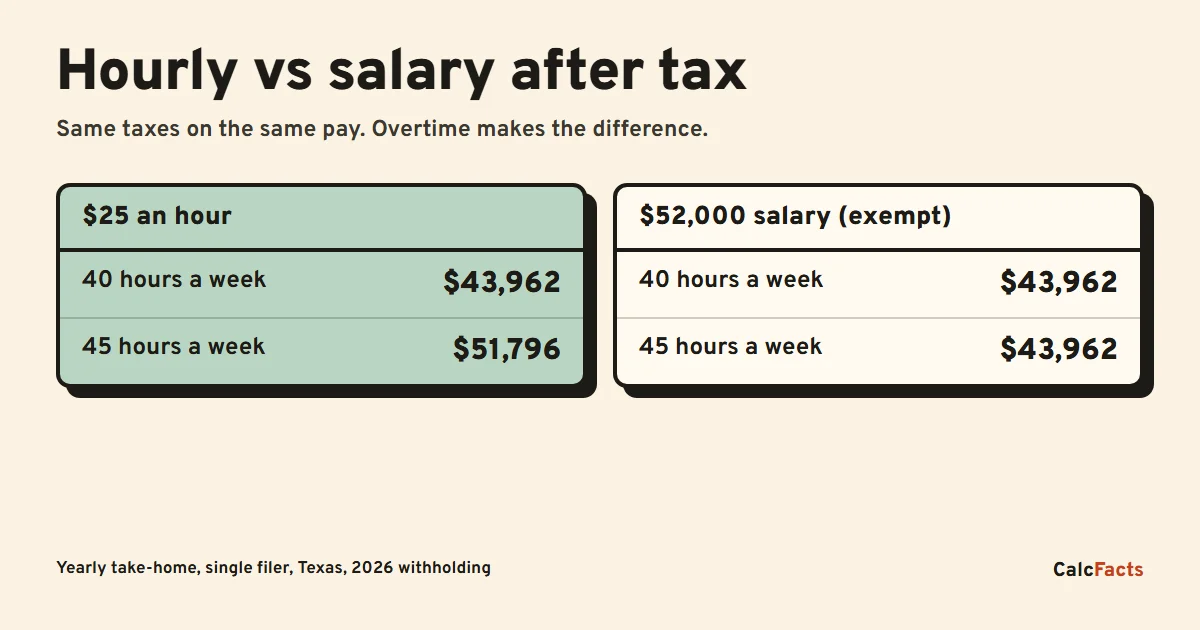
Neither one is taxed more. The IRS treats hourly pay and a salary the same way: both are wages, and “it doesn’t matter how you measure or make the payments” (IRS Publication 15). At the same yearly pay, with the same W-4 and pre-tax deductions, federal income tax, Social Security and Medicare come out the same, and state income taxes also apply to wages however they’re figured. A $25-an-hour job at 40 hours a week and a $52,000 salary both take home $43,962 a year for a single filer in Texas in 2026.
What changes the answer is hours. Hourly workers covered by federal overtime law are usually owed time and a half for hours over 40 in a week; many salaried workers aren’t. Work 45 hours a week, and the hourly job takes home $51,796, $7,834 more than the salary. This guide shows where the difference comes from, how to compare a salary offer with an hourly one, and the 2025–2028 tax deduction for FLSA overtime. For your own numbers, use the paycheck calculator.
Last updated November 11, 2026 · Tax review: pending sign-off by a licensed tax professional (EA/CPA)
Key Takeaways
- Taxes don’t favor hourly or salary. The same yearly wages are taxed the same way.
- The gap comes from overtime: non-exempt employees, hourly or salaried, get at least 1.5× their regular rate for hours over 40 in a workweek.
- A salary is the same whether you work 40 hours or 50, so long weeks lower your real hourly rate: $52,000 for 50-hour weeks is $20 an hour.
- To compare offers, divide the salary by the hours you’ll really work, and compare that with the hourly rate plus overtime.
- For 2025 through 2028, the FLSA overtime premium (the “half” in time and a half) can be deducted from federal taxable income, up to $12,500 ($25,000 joint), with an income phase-out.
Is Hourly or Salary Taxed More?
Neither. Pay is wages for tax purposes whether it’s figured by the hour or set as a yearly salary. IRS Publication 15 says wages “generally include all pay you give to an employee for services performed,” including “salaries, vacation allowances, bonuses, commissions, and taxable fringe benefits,” and that “it doesn’t matter how you measure or make the payments” (IRS Publication 15).
So your employer withholds federal income tax from each paycheck based on your Form W-4, and takes 6.2% for Social Security on wages up to $184,500 in 2026 and 1.45% for Medicare on all wages (7.65% in total below the cap), the same way for both (IRS Topic 751; see FICA tax). Two people who earn $52,000 a year in the same state, with the same W-4 and pre-tax deductions, have the same take-home pay. If one of them earns more because of overtime, they pay more tax on the extra, but they also keep most of it.
Why Hourly Can Pay More: Overtime
Under the Fair Labor Standards Act, non-exempt employees must get “time and one-half the regular rate of pay for all hours worked over 40 hours in a workweek” (DOL Fact Sheet #17A). The main white-collar exemptions require pay on a salary basis (29 CFR 541.600), so most hourly employees covered by the FLSA are owed overtime. Exceptions include some computer professionals paid by the hour, outside salespeople, teachers, doctors and lawyers, and jobs covered by other FLSA exemptions; see who is exempt from overtime. A salaried employee who’s exempt from overtime gets the same salary whether the week is 40 hours or 50.
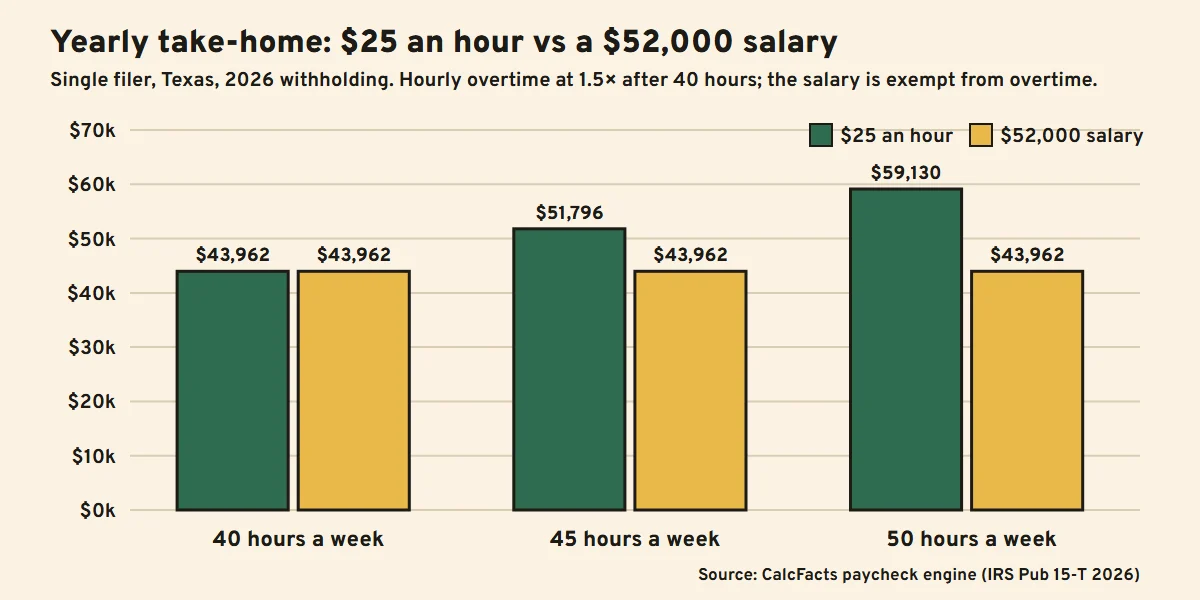
Take a $25-an-hour job next to a $52,000 salary that’s exempt from overtime, for a single filer in Texas in 2026 (no state income tax, paid every two weeks, standard W-4, no pre-tax deductions, the same hours every week, and 52 paid weeks; the overtime deduction below isn’t included):
| Hours a week | Hourly: gross a year | Hourly: take-home | Salary: take-home | Salary’s real hourly rate |
|---|---|---|---|---|
| 40 | $52,000 | $43,962 | $43,962 | $25.00 |
| 45 | $61,750 | $51,796 | $43,962 | $22.22 |
| 50 | $71,500 | $59,130 | $43,962 | $20.00 |
At 45 hours, the 5 overtime hours are paid at $37.50, adding $9,750 a year before tax and $7,834 after. In a state with an income tax the gap is smaller: in California, withholding for state income tax and 1.3% SDI (2026) takes about $770 more, so take-home rises by about $7,064. Many hourly jobs don’t pay for vacation weeks, which would lower the hourly column. These figures come from the CalcFacts paycheck engine, so they’re paycheck withholding; your final tax is settled when you file.
Salaried Doesn’t Always Mean Exempt
Being paid a salary doesn’t by itself make you exempt from overtime. For most of the executive, administrative and professional exemptions, both your pay and your job duties have to pass the tests (teachers, doctors and lawyers have no salary test): “an employee’s specific job duties and salary must meet all the requirements” (DOL Fact Sheet #17G), and “a job title alone is insufficient to establish the exempt status of an employee” (29 CFR 541.2).
The salary test the Department of Labor currently applies is “$684 per week (equivalent to a $35,568 annual salary)” (DOL: salary levels; see 29 CFR 541.600), and “$107,432 per year, including at least $684 per week paid on a salary or fee basis” for highly compensated employees (DOL: salary levels). Below $684 a week, you generally can’t be exempt under those three exemptions, even if you’re paid a salary. You may see higher figures elsewhere that came from a 2024 rule; the current regulation and DOL’s salary-levels page list $684.
If you’re salaried but non-exempt, you’re owed overtime too. Your regular rate is figured “by dividing the salary by the number of hours which the salary is intended to compensate” (29 CFR 778.113): a $900 weekly salary for a 40-hour week is $22.50 an hour, so overtime is at least $33.75 an hour. States can set higher salary levels or stricter rules; for example, see California overtime law.
The Tax Break for FLSA Overtime
For 2025 through 2028, people who earn qualified overtime can deduct “the pay that exceeds their regular rate of pay,” such as the half in time and a half, “that is required by the Fair Labor Standards Act (FLSA)” (IRS FS-2025-03). The deduction is up to $12,500 a year ($25,000 on a joint return) and shrinks by $100 for every full $1,000 of modified AGI above $150,000 ($300,000 joint). Only FLSA-required overtime counts, not extra overtime paid under state law or a union contract; you need a valid Social Security number, and married couples must file jointly (26 U.S.C. § 225).
In the example, 5 overtime hours a week at $25 an hour carry a premium of $12.50 an hour, $3,250 a year. Deducting it lowers federal income tax by about $390 for a single filer taking the standard deduction. At 50 hours the premium is $6,500 and the saving about $1,280, because most of it ($5,000) comes off income taxed at 22%: $5,000 × 22% + $1,500 × 12%. The deduction lowers income tax only; Social Security and Medicare still apply to all overtime pay. An exempt salaried employee has no overtime premium to deduct. See no tax on overtime explained for the rules, or estimate yours with the no tax on overtime calculator.
How to Compare a Salary Offer With an Hourly One
Turn the salary into an hourly rate using the hours you’ll really work, not 40:
- Estimate your real weekly hours in the salaried job, including evenings and weekends.
- Divide the salary by those hours × 52. $60,000 for 45-hour weeks is $60,000 ÷ 2,340 = $25.64 an hour.
- Compare with the hourly offer, counting overtime. For the same pay at 45 hours, an hourly job needs only salary ÷ 2,470 per hour, because the 5 overtime hours count as 7.5: $60,000 ÷ 2,470 = $24.29.
- Then compare everything else: paid time off, health insurance, retirement matching, and how steady the hours are.
| Salary | Hourly rate at 40 hours | Real rate at 45 hours | Hourly rate that matches at 45 hours with overtime | Real rate at 50 hours |
|---|---|---|---|---|
| $40,000 | $19.23 | $17.09 | $16.19 | $15.38 |
| $52,000 | $25.00 | $22.22 | $21.05 | $20.00 |
| $60,000 | $28.85 | $25.64 | $24.29 | $23.08 |
| $75,000 | $36.06 | $32.05 | $30.36 | $28.85 |
To convert any salary or wage, use the salary to hourly calculator or the hourly to salary calculator.
When a Salary Comes Out Ahead
Hourly pay wins on long weeks, but a salary has its own advantages:
- Steady pay. An exempt employee must get “the full salary … for any week in which the employee performs any work without regard to the number of days or hours worked” (29 CFR 541.602), with limited exceptions. An hourly paycheck shrinks in a short week.
- Short weeks. If you’d often work under 40 hours, a salary pays the same anyway.
- Benefits. Health insurance and retirement matching aren’t paid as wages, and paid leave varies by employer, so compare them separately.
Frequently Asked Questions
Do salaried employees pay more taxes than hourly?
No. At the same yearly pay, the taxes are the same. Hourly workers who earn more because of overtime pay more tax in dollars, but on higher pay.
Is it better to be hourly or salary?
It depends on your hours and the rates. At the same base pay, hourly usually pays more if you often work over 40 hours and you’d be non-exempt. To compare different offers, divide the salary by your real hours and compare that with the hourly rate plus overtime. If your hours are short or unpredictable, a salary gives steadier pay.
How much is $52,000 a year hourly?
$25 an hour at 40 hours a week (2,080 hours a year). If you really work 45 hours a week, it’s $22.22 an hour.
Can a salaried employee get overtime?
Yes, if they’re non-exempt. Being salaried doesn’t make you exempt: for most white-collar exemptions, you must be paid at least $684 a week on a salary basis and your duties must meet the test.
Does overtime get taxed more?
No. Overtime is taxed like other wages; it can raise your paycheck’s withholding because that paycheck is bigger, and overtime paid in a separate check may be withheld at a flat supplemental rate (IRS Publication 15). For 2025 through 2028, the FLSA overtime premium can also be deducted from federal taxable income, with limits.
The Bottom Line
Hourly and salaried pay are taxed the same, so the real comparison is pay per hour you actually work. At the same base pay, if your hours run long and you’d be non-exempt, hourly pay with overtime usually comes out ahead, and the overtime deduction adds a little more through 2028. If your hours are short or you value steady pay, a salary can be the better deal. Run both offers through the paycheck calculator to see your take-home pay, and see how a raise would change it with the pay raise calculator.
About this guide: about us · editorial policy · how we calculate · contact
This guide is for general education and is not tax or legal advice. Sources were reviewed on November 11, 2026. The overtime-law sections haven’t been reviewed by an employment lawyer; for decisions about your own job or taxes, consult a qualified professional.
Sources
- IRS Publication 15 (Circular E), Employer’s Tax Guide: Wages and other compensation
- IRS Topic No. 751, Social Security and Medicare withholding rates
- U.S. Department of Labor, Fact Sheet #17A: Exemption for executive, administrative, professional, computer and outside sales employees under the FLSA
- U.S. Department of Labor, Fact Sheet #17G: Salary basis requirement and the Part 541 exemptions
- U.S. Department of Labor: Salary levels for the Part 541 exemptions
- 29 CFR 541.2, 541.600 and 541.602
- 29 CFR 778.113, Salaried employees: general
- IRS FS-2025-03, Working Families Tax Cuts: tax deductions for working Americans and seniors
- 26 U.S.C. § 225, Qualified overtime compensation
- IRS Publication 15-T, Federal Income Tax Withholding Methods and California EDD, contribution rates and withholding schedules
- Take-home figures: CalcFacts paycheck methodology (2026 withholding, single filer, Texas and California, paid every two weeks)