
California Overtime Law 2026: Daily, Weekly & 7th-Day Rules
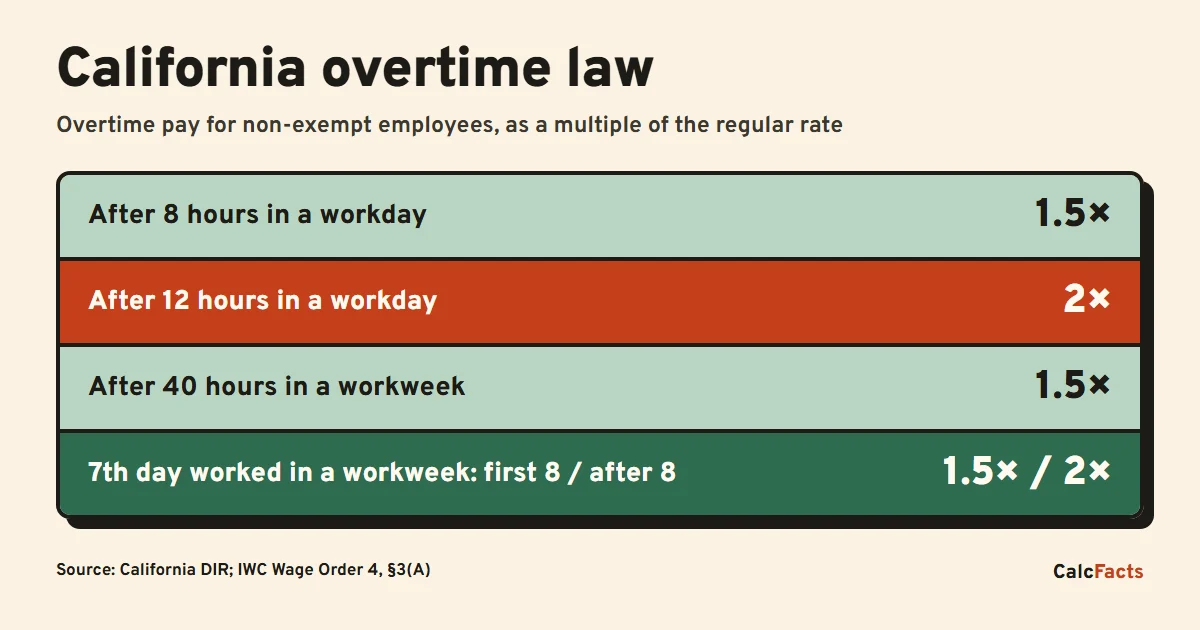
California overtime law is stricter than federal law. Non-exempt employees earn 1.5 times their regular rate for hours over 8 in a workday or over 40 in a workweek, and double their regular rate for hours over 12 in a workday. On the seventh consecutive day of work in a workweek, the first 8 hours are paid at 1.5 times and anything beyond 8 at double time (California Department of Industrial Relations). Federal law generally requires overtime only after 40 hours a week. These rules come from California Labor Code §510 and the Industrial Welfare Commission’s Wage Order 4; the state has separate wage orders for different industries and occupations, and most repeat these overtime rules, but some groups differ (DIR, which wage order applies).
The daily rule is what changes paychecks most. At $25 an hour, four 10-hour days total 40 hours, so federal law owes no overtime: $1,000. California counts 2 overtime hours each day, so the same week pays $1,100. This guide covers each rule, how they fit together without counting an hour twice, 12-hour shifts and 4/10 schedules, who is exempt, and how California overtime interacts with the federal “no tax on overtime” deduction. To run your own week, use the overtime calculator in California mode.
Last updated November 10, 2026 · Review: pending sign-off by a qualified professional
Key Takeaways
- Daily overtime: 1.5× for hours over 8 in a workday, up to 12; 2× for hours over 12.
- Weekly overtime: 1.5× for straight-time hours over 40 in a workweek; hours already paid as daily overtime don’t count again.
- Seventh consecutive day in a workweek: 1.5× for the first 8 hours, 2× after 8.
- An alternative workweek of up to 10-hour days, adopted by a two-thirds secret-ballot vote, avoids daily overtime within the schedule. 12-hour shifts still earn overtime after 10 hours, except under the health care rules.
- The executive, administrative and professional exemptions need qualifying duties and, in 2026, a salary of at least $70,304 a year (2 × the $16.90 minimum wage, full time).
- Only the part of California overtime that federal law also requires counts toward the 2025–2028 federal overtime deduction.
California Overtime Rules at a Glance
| When you work | California rate | Federal rate |
|---|---|---|
| Hours over 8 in a workday, up to 12 | 1.5× | None (unless over 40 for the week)* |
| Hours over 12 in a workday | 2× | None (unless over 40 for the week)* |
| Hours over 40 in a workweek | 1.5× | 1.5× |
| Seventh consecutive workday in a workweek: first 8 hours | 1.5× | None (unless over 40 for the week) |
| Seventh consecutive workday in a workweek: hours over 8 | 2× | None (unless over 40 for the week) |
California: DIR overtime FAQ and IWC Wage Order 4, §3(A). Federal: U.S. Department of Labor. * Federally, hospitals and residential care establishments may instead use an agreed 14-day period with overtime after 8 hours a day and 80 hours in the period (29 CFR 778.601).
The rates multiply your regular rate, which includes more than your hourly wage: salary, piecework, commissions and nondiscretionary bonuses all count (DIR).
Daily Overtime: After 8 Hours, Double Time After 12
California measures overtime by the workday, defined as “a consecutive 24-hour period beginning at the same time each calendar day,” which an employer can set to start at any time of day. Each workday stands on its own: “the averaging of hours over two or more workdays is not allowed” (DIR glossary).
Within a workday:
- Hours 1–8 are straight time.
- Hours 9–12 are paid at 1.5 times your regular rate.
- Hours after 12 are paid at double time.
Example: one 13-hour day at $25 an hour is 8 straight-time hours ($200), 4 hours at $37.50 ($150) and 1 hour at $50 ($50), so $400. Under federal rules alone, the same day pays $325 if the week stays at 40 hours or less.
Weekly Overtime and the Seventh Consecutive Day
California also pays 1.5 times for hours over 40 in a workweek: “a fixed and regularly recurring period of 168 hours, seven consecutive 24-hour periods” (DIR glossary). It doesn’t have to start on Monday, but it must be fixed and regularly recurring; an employer can change it only permanently, and not to avoid overtime (DIR glossary).
If you work all seven days of a workweek, the seventh day has its own rule: the first 8 hours are paid at 1.5 times, and hours over 8 at double time (IWC Wage Order 4, §3(A)(1)). The wage order permits working more than six days in a workweek if it’s paid at these rates, but employees are also guaranteed a day of rest in each workweek, with exceptions, such as for employees who never work more than 6 hours on any day of the workweek: an employer can’t induce you to give it up, though you can choose to work it (Mendoza v. Nordstrom, Inc., California Supreme Court, 2017), and you can’t be disciplined for refusing the seventh day (see below).
Example: an employee on 6-hour shifts who works every day of a workweek, at $25 an hour, works 42 hours. The 6 hours on the seventh day are overtime under the seventh-day rule, so the week pays 36 straight-time hours plus 6 overtime hours: $1,125. Federal rules count only the 2 hours over 40, so $1,075.
How Daily and Weekly Overtime Fit Together
An hour is paid at one overtime rate, never two. California’s Labor Commissioner puts it this way: “Once an hour is counted as an overtime hour under some form of overtime, it cannot be counted as an hour worked for the purpose of another form of overtime” (DLSE, Understanding AB 60). That gives this order:
- Count daily overtime (hours 9–12) and double time (after 12) for each workday, and apply the seventh-day rule if you worked all seven days.
- Add up the hours that were paid at straight time.
- If those straight-time hours are over 40, the hours above 40 are weekly overtime at 1.5 times. Hours already paid as daily overtime aren’t counted again: in the Labor Commissioner’s own example, four 12-hour days give 16 daily overtime hours and no weekly overtime, because only the 32 regular hours count toward 40 (DLSE, above).
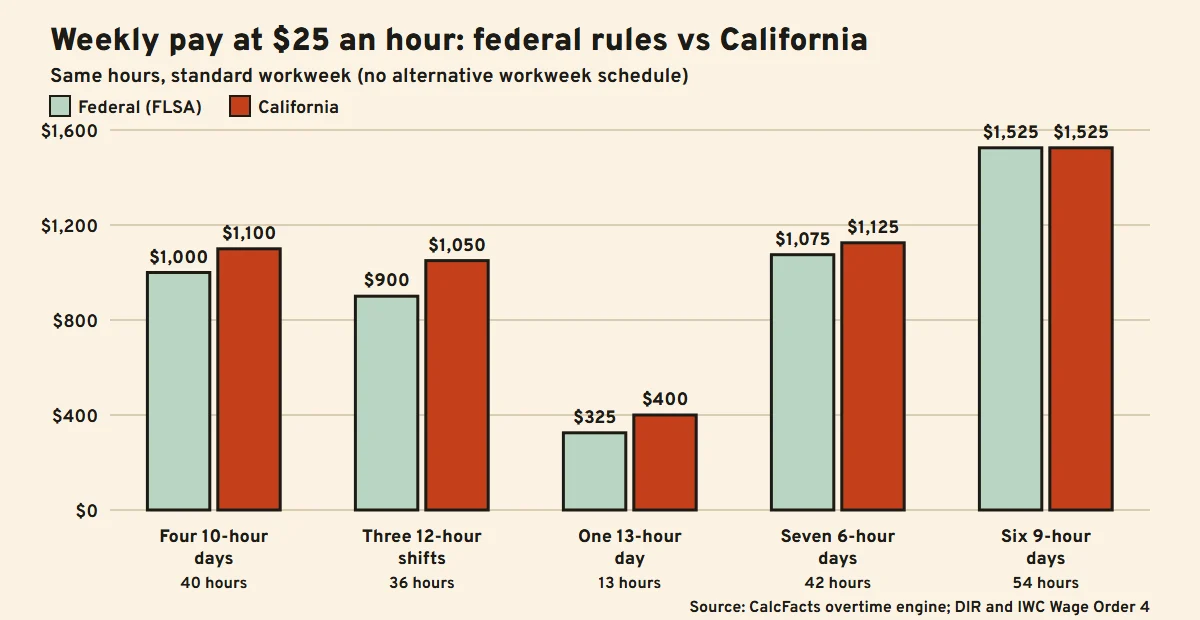
| Week at $25 an hour | Hours | California overtime (1.5× / 2×) | California pay | Federal pay | Qualified for the federal deduction |
|---|---|---|---|---|---|
| Four 10-hour days | 40 | 8 / 0 | $1,100 | $1,000 | $0 |
| Three 12-hour shifts | 36 | 12 / 0 | $1,050 | $900 | $0 |
| One 13-hour day | 13 | 4 / 1 | $400 | $325 | $0 |
| Seven 6-hour days | 42 | 6 / 0 | $1,125 | $1,075 | $25 |
| Six 9-hour days | 54 | 14 / 0 | $1,525 | $1,525 | $175 |
Calculated with the CalcFacts overtime engine. “Qualified” is the half-time premium on hours over 40, the part federal law requires.
The six 9-hour days show why the order matters: 6 daily overtime hours plus 8 more weekly hours make 14 overtime hours, the same total federal law gives, so neither system pays more there. California pulls ahead when long days don’t add up to more than 40 hours, or when you work every day of the workweek.
12-Hour Shifts and 4/10 Schedules: Alternative Workweeks
Without a special agreement, every hour over 8 in a workday is overtime, so a 4/10 or 3/12 schedule costs an employer daily overtime: three 12-hour shifts at $25 pay $1,050, not $900.
An alternative workweek schedule changes that. An employer can set a regular schedule of “not more than ten (10) hours per day within a 40 hour workweek” without paying daily overtime, but only if at least two-thirds of the affected employees approve it in a secret-ballot vote held before the work starts (IWC Wage Order 4, §3(B)(1) and §3(C)(2)). The employer must first give written disclosure of the schedule’s effects and hold meetings at least 14 days before the vote, the schedule must provide at least 4 hours of work in any shift, and the results must be reported to the state within 30 days (§3(B)(1), §3(C)(3) and §3(C)(6)). Under a valid schedule:
- Work beyond the scheduled hours in a day, up to 12, and work over 40 in the week is paid at 1.5 times.
- Work over 12 hours in a day, and over 8 hours on extra days beyond the scheduled number of workdays, is paid at double time.
12-hour shifts. A vote can’t make a 12-hour shift overtime-free in most jobs, because the alternative workweek tops out at 10 hours a day. Under a 10-hour schedule, hours 11 and 12 are still paid at 1.5 times, so three 12-hour shifts at $25 earn 6 overtime hours: $975. The exception is the health care industry, where Wage Order 4 allows alternative workweeks with workdays of more than 10 and up to 12 hours under extra conditions, with double time after 12 (§3(B)(8)). The overtime calculator doesn’t model alternative workweek schedules.
California vs Federal Overtime
| California | Federal (FLSA) | |
|---|---|---|
| Daily overtime | After 8 hours (1.5×) and 12 hours (2×) | None, except hospital and residential care 8-and-80 agreements |
| Weekly overtime | After 40 hours (1.5×) | After 40 hours (1.5×) |
| Seventh consecutive day | 1.5× first 8 hours, 2× after | No special rule |
| Double time | Required over 12 hours, and over 8 on the seventh day | Never required |
| Averaging | Not allowed across workdays or workweeks | Not allowed across workweeks, except 8-and-80 14-day periods |
Who Is Exempt? The $70,304 Salary Test (2026)
“A salaried employee must be paid overtime unless they meet the test for exempt status” (DIR). For the executive, administrative and professional exemptions, California’s wage orders require both (other exemptions and some occupations use different tests):
- Duties: the employee must be primarily engaged in exempt work, which means “more than one-half the employee’s work time.”
- Salary: a “monthly salary equivalent to no less than two (2) times the state minimum wage for full-time employment,” with full time defined as 40 hours a week (IWC Wage Order 4, §1(A) and §2(O)).
With California’s 2026 minimum wage of $16.90 an hour (DIR), that’s 2 × $16.90 × 2,080 hours = $70,304 a year, or $5,858.67 a month. That’s far above the federal minimum of $684 a week (29 CFR 541.600). Being paid a salary doesn’t make you exempt by itself; for the federal tests, see who is exempt from overtime pay.
Can Your Employer Require Overtime?
Generally, yes. California’s Labor Commissioner says that, in general, “an employer may dictate the employee’s work schedule and hours,” and an employee who refuses scheduled overtime can usually be disciplined. The exception: “an employer cannot discipline an employee for refusing to work on the 7th day in a workweek” (DIR). Required overtime must still be paid at the overtime rates.
California Overtime and the Federal “No Tax on Overtime” Deduction
The federal overtime deduction for 2025 through 2028 only covers overtime the Fair Labor Standards Act requires, so most California daily overtime doesn’t count. The IRS lists “hours beyond 8 on a workday” as overtime that goes beyond the FLSA, and says that if you’re eligible, only the part the FLSA would have required is qualified (IRS Fact Sheet 2026-13, Q16).
In the table above, four 10-hour days earn $100 of California overtime premium but $0 qualifies, because the week is only 40 hours. Six 9-hour days qualify $175: the half-time premium on the 14 hours over 40.
The gap is widest for salaried workers who are exempt under federal rules but not under California’s. If your duties are exempt under federal rules and you earn at least $684 a week but less than $70,304 a year, California owes you overtime, but none of it is qualified: the IRS says an employee who isn’t FLSA overtime-eligible “does not receive qualified overtime compensation regardless of other laws or circumstances” (FS-2026-13, Q4). Our guide to qualified overtime compensation explains the IRS formula, and the no tax on overtime calculator estimates the deduction.
Frequently Asked Questions
Is overtime in California after 8 hours or 40 hours?
Both. Non-exempt employees earn 1.5 times for hours over 8 in a workday and for hours over 40 in a workweek, and an hour is only paid once. Hours over 12 in a day are double time.
Can you work 4-10 hour days in California without overtime?
Only under a valid alternative workweek schedule, adopted by a two-thirds secret-ballot vote of the affected employees before the work starts. Without one, each 10-hour day includes 2 hours of daily overtime.
Do 12-hour shifts get overtime in California?
Yes, in most jobs. Without an alternative workweek, hours 9–12 are paid at 1.5 times: three 12-hour shifts at $25 pay $1,050. Under a 10-hour alternative workweek, hours 11 and 12 are still overtime ($975 for the same week). Under Wage Order 4, only health care employers can adopt alternative workweeks with workdays of up to 12 hours.
Is overtime mandatory in California?
Your employer can generally schedule overtime and discipline you for refusing it, but can’t discipline you for refusing to work the seventh day in a workweek. All overtime must be paid at the required rates.
Do salaried employees get overtime in California?
Yes, unless they’re exempt. The executive, administrative and professional exemptions need qualifying duties more than half the time and a salary of at least two times the state minimum wage for full-time work: $70,304 a year in 2026. For overtime, California sets a salaried non-exempt employee’s regular rate at the weekly salary divided by 40 (DIR).
What are the new overtime rules for 2026?
The overtime rates and hour thresholds didn’t change. What changed is the minimum wage, $16.90 an hour in 2026 (up from $16.50), which raises the salary needed for the exemptions to $70,304. Separately, the federal overtime deduction for 2025–2028 applies only to FLSA-required overtime.
How do I calculate California overtime pay?
For each workday, split hours into straight time (up to 8), 1.5 times (9–12) and double time (over 12); apply the seventh-day rule if you worked all seven days; then pay 1.5 times for any straight-time hours over 40 in the week. Total your daily hours with the time card calculator and run the week in the overtime calculator’s California mode.
The Bottom Line
- California overtime starts after 8 hours in a day or 40 in a week, with double time after 12 hours and on the seventh day after 8.
- Each hour is paid at one overtime rate; hours paid as daily overtime don’t count again toward 40.
- 4/10 schedules avoid daily overtime only under a voted alternative workweek; 12-hour shifts still earn overtime after 10 hours, except under the health care rules.
- The executive, administrative and professional exemptions need the duties test and, in 2026, a salary of at least $70,304.
- Only FLSA-required overtime counts toward the federal overtime deduction.
For take-home pay after tax, use the California paycheck calculator.
About this guide: about us · editorial policy · how we calculate · contact
This guide is general information, not legal advice. Sources were reviewed on November 10, 2026. Some industries and occupations follow different wage orders or exemptions; for your own situation, contact the California Labor Commissioner or an employment attorney.
Sources
- California Department of Industrial Relations, Labor Commissioner: Overtime FAQ
- California Department of Industrial Relations: Glossary (workday, workweek)
- California Code of Regulations, Title 8, §11040: IWC Wage Order 4
- California DLSE, Understanding AB 60 (no pyramiding of overtime)
- California DIR, Which wage order applies
- Mendoza v. Nordstrom, Inc. (California Supreme Court, 2017)
- 29 CFR 778.601 (hospital 8-and-80) and 29 CFR 541.600 (federal salary level)
- California Department of Industrial Relations: Minimum Wage FAQ
- U.S. Department of Labor: Overtime Pay
- IRS Fact Sheet 2026-13: Qualified overtime compensation