
Weighted vs. Unweighted GPA: What's the Difference?
An unweighted GPA counts every class on the same 4.0 scale: an A is 4.0 whether the class is regular, honors or AP. A weighted GPA adds bonus points for harder classes, so it can go above 4.0. In North Carolina’s statewide system, for example, an honors class adds 0.5 and an AP, IB or college class adds 1.0, so an A in AP counts as 5.0 (NC State Board of Education, GRAD-009).
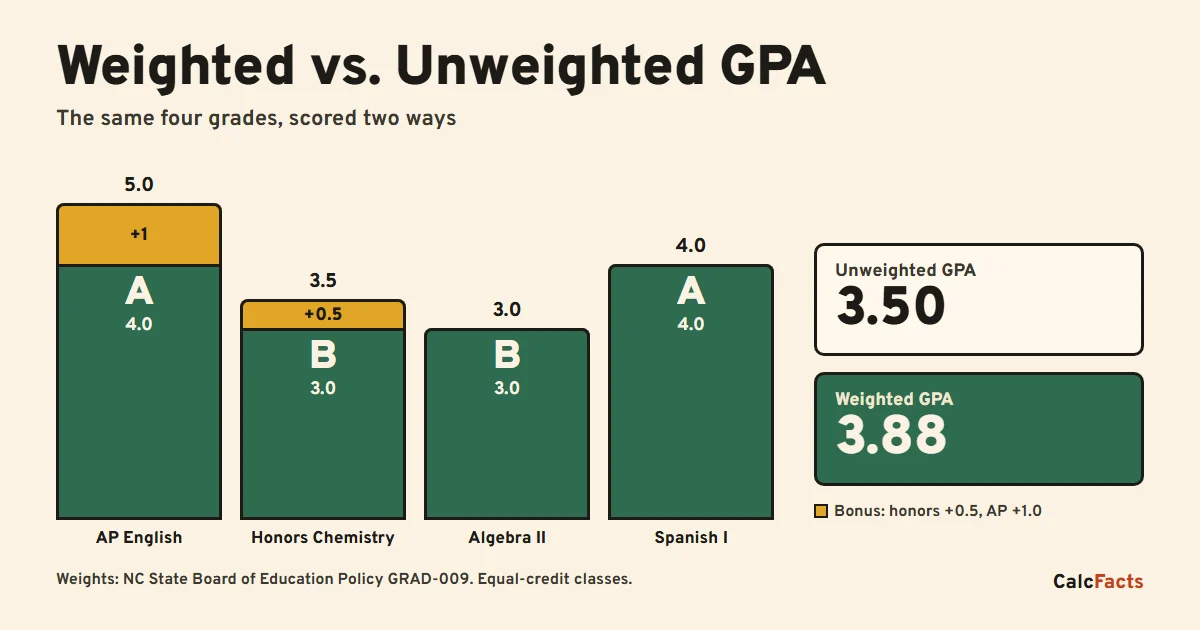
Same grades, two numbers. A student with an A in AP English, a B in honors chemistry, a B in algebra and an A in Spanish has a 3.50 unweighted GPA and a 3.88 weighted GPA on North Carolina’s scale. This guide shows how each one works, why you can’t convert between them exactly, and which one colleges look at.
Last updated November 14, 2026 · Review: pending sign-off by an education reviewer (school counselor or teacher)
Key Takeaways
- Unweighted GPA: every class on a 4.0 scale (A = 4, B = 3, C = 2, D = 1).
- Weighted GPA: bonus points for advanced classes. North Carolina adds 0.5 for honors and 1.0 for AP, IB, Cambridge and college classes.
- Bonuses aren’t universal. Each state, district or school sets its own, and some give none to low grades.
- You can’t turn a weighted GPA into an exact unweighted one without the course list, but you can find the range.
- Colleges may recalculate your GPA their own way. The University of California, for example, ignores pluses and minuses and caps honors points (College Board; UC Admissions).
In this guide
- Weighted vs. Unweighted GPA at a Glance
- How an Unweighted GPA Works
- How a Weighted GPA Works
- Example: One Transcript, Two GPAs
- Can You Convert a Weighted GPA to Unweighted?
- Which GPA Do Colleges Look At?
- Frequently Asked Questions
- The Bottom Line
Weighted vs. Unweighted GPA at a Glance
| Unweighted GPA | Weighted GPA | |
|---|---|---|
| What it measures | Your grades only | Your grades plus how hard your classes were |
| Scale | 0 to 4.0 | Above 4.0 is possible (5.0 for an A at North Carolina’s top weight) |
| An A in AP or IB | 4.0 | 5.0 in North Carolina |
| An A in honors | 4.0 | 4.5 in North Carolina |
| An A in a regular class | 4.0 | 4.0 |
| Same everywhere? | Usually A = 4 through F = 0, though plus/minus values vary | No. Bonuses differ by state, district and school |
| On a North Carolina transcript | Yes | Yes, both are required |
Source: NC State Board of Education, Policy GRAD-009. North Carolina’s policy says students “shall receive both an un-weighted GPA that reflects no additional weighting for advanced courses and a weighted GPA that reflects additional quality points for advanced coursework.”
How an Unweighted GPA Works
An unweighted GPA turns each letter grade into points on a 4.0 scale and averages them: A = 4, B = 3, C = 2, D = 1 and F = 0. College Board describes the basic calculation the same way: add each class’s grade points and divide by the number of classes (College Board BigFuture). When classes carry different credits, multiply each grade’s points by its credits first.
Schools with plus and minus grades use in-between values, such as 3.7 for an A- and 3.3 for a B+; our letter grades guide lists them. Either way, an unweighted 4.0 scale tops out at 4.0, so a 4.0 means straight A’s (a few colleges count an A+ as 4.3).
The national average for high school graduates, 3.11 for the class of 2019, is reported on a 4.0 scale, so compare it with your unweighted GPA (NAGB, 2019 High School Transcript Study). There’s no reliable national average for weighted GPA (average high school GPA).
How a Weighted GPA Works
A weighted GPA starts with the same points and adds a bonus for advanced classes. North Carolina’s State Board of Education sets these weights statewide (GRAD-009):
| Course level | Bonus | A | B | C |
|---|---|---|---|---|
| Standard | none | 4.0 | 3.0 | 2.0 |
| Honors | +0.5 | 4.5 | 3.5 | 2.5 |
| AP, IB or Cambridge (CIE) | +1.0 | 5.0 | 4.0 | 3.0 |
| College or dual-enrollment course | +1.0 | 5.0 | 4.0 | 3.0 |
The policy also gives honors weighting to some courses automatically, including pre-calculus, non-AP calculus and world languages beyond the second year. It calculates official class rank from the weighted GPA, with bonus points given for passing grades.
Other schools draw the lines differently. Alexandria City High School in Virginia uses the same 4 / 4.5 / 5 pattern for an A in regular, honors and AP classes, but gives no bonus at all for a C- or lower: a C- is 1.7 at every level (Alexandria City High School). So a weighted GPA from one school isn’t directly comparable with one from another.
Example: One Transcript, Two GPAs
Here’s one semester of four equal-credit classes, scored with North Carolina’s weights:
| Class | Level | Grade | Unweighted points | Weighted points |
|---|---|---|---|---|
| English | AP | A | 4.0 | 5.0 |
| Chemistry | Honors | B | 3.0 | 3.5 |
| Algebra II | Standard | B | 3.0 | 3.0 |
| Spanish I | Standard | A | 4.0 | 4.0 |
| GPA | 3.50 | 3.88 |
Unweighted: (4.0 + 3.0 + 3.0 + 4.0) ÷ 4 = 14 ÷ 4 = 3.50. Weighted: (5.0 + 3.5 + 3.0 + 4.0) ÷ 4 = 15.5 ÷ 4 = 3.875, or 3.88. The difference, 0.375, is just the average bonus: (1.0 + 0.5 + 0 + 0) ÷ 4. Our GPA calculator shows both numbers side by side for your own classes, with credits.
Can You Convert a Weighted GPA to Unweighted?
Not exactly, from the GPA alone. A weighted GPA is your unweighted GPA plus your average bonus, and the average bonus depends on how many of your classes were honors or AP. Two students with a 4.2 weighted GPA can have very different unweighted GPAs.
You can find the range, though. On a scale like North Carolina’s, where the bonus is never more than 1.0, the average bonus is somewhere between 0 and 1.0. So:
- Unweighted GPA is at most your weighted GPA, and never more than 4.0.
- Unweighted GPA is at least your weighted GPA minus 1.0.
| Weighted GPA | Possible unweighted GPA (bonus of 0 to 1.0) |
|---|---|
| 4.5 | 3.5 to 4.0 |
| 4.2 | 3.2 to 4.0 |
| 4.0 | 3.0 to 4.0 |
| 3.7 | 2.7 to 3.7 |
| 3.5 | 2.5 to 3.5 |
So under North Carolina’s weights, a 4.2 weighted GPA is a 3.2 to 4.0 unweighted, and a 3.7 weighted GPA is a 2.7 to 3.7 unweighted. To see what a 3.7 means as a letter grade, check the 3.7 GPA page.
To pin it down, list your classes and grades and compute both, or check your transcript: your school may print both GPAs, as North Carolina’s transcripts must. If your school’s bonus is smaller (or bigger), the range changes with it.
Which GPA Do Colleges Look At?
Possibly neither, at least not exactly as your school reports it. College Board says that “colleges may recalculate your GPA based on their own criteria.” They may drop noncore classes, focus on core subjects, and “adjust or remove weighting assigned to AP or honors to standardize GPAs across applicants,” and “some colleges may apply their own weighting system” (College Board BigFuture).
The University of California is a clear example. It calculates its own GPA for every applicant (UC Admissions):
- It uses A-G courses from the summer after 9th grade through the summer after 11th grade.
- A = 4, B = 3, C = 2, D = 1, and “pluses and minuses don’t count.”
- California residents get one extra point for each semester of an honors-level course (AP, IB HL and some SL, UC-transferable college courses and UC-certified honors), up to 4 points in 10th grade and 8 points across 10th and 11th grades.
- “Grades of D or F in an honors course do not earn an extra point.”
- Nonresidents get the extra point only for AP and IB grades of A, B or C.
- The minimum is 3.0 for residents and 3.4 for nonresidents, and UC says, “Do not round up or down.”
Even if a college strips the bonus out, your transcript still shows which classes were honors or AP. College Board’s advice is to ask each college’s admissions office how it evaluates GPA.
So which is “better”? Neither. An unweighted GPA tells you how high your grades are; a weighted GPA also reflects how hard your classes were. Report the GPA your application asks for, exactly as your transcript shows it, and see what counts as strong in our guide to a good high school GPA.
Frequently Asked Questions
Is a 5.0 GPA weighted or unweighted?
Weighted. An unweighted scale tops out at 4.0. On North Carolina’s scale, a 5.0 means an A in every class, with every class at the AP, IB, Cambridge or college level.
Can an unweighted GPA be above 4.0?
Not on a standard 4.0 scale. A few colleges count an A+ as 4.3, such as Cornell (Cornell University Registrar), so their GPAs can go slightly over 4.0 without any weighting. See letter grades explained.
Is a 4.25 weighted GPA good?
It’s above 4.0, so at least some of your classes were weighted. Under North Carolina’s weights, the unweighted equivalent is anywhere from 3.25 (about a B+ average, with every class AP) to 4.0 (straight A’s, with half your classes honors or a quarter AP), so the number alone doesn’t say how strong your grades are. Compare your unweighted GPA with the 3.11 national average, and check the colleges you’re aiming for, keeping in mind they may recalculate it.
Is cumulative GPA weighted or unweighted?
It can be either. “Cumulative” just means it covers every term so far, not only the latest one. Schools that report both, like North Carolina’s, give a cumulative weighted GPA and a cumulative unweighted GPA. The GPA calculator can add a new term to your cumulative GPA.
Do colleges prefer weighted or unweighted GPA?
It depends on the college. Colleges may recalculate GPA themselves, removing or adjusting weighting, and some apply their own weights, as UC does. Ask each admissions office, as College Board recommends.
The Bottom Line
- An unweighted GPA averages grades on a 4.0 scale; a weighted GPA adds bonuses for honors, AP, IB and college classes and can exceed 4.0.
- In North Carolina, honors adds 0.5 and AP, IB, Cambridge and college classes add 1.0; other schools set their own rules.
- The gap between the two is your average bonus, so a weighted GPA converts to an unweighted range, not one number.
- Colleges may recalculate both. UC ignores pluses and minuses and caps honors points at 8.
Work out both of your GPAs with the GPA calculator, see what any GPA means as a letter on the GPA scale, or browse the grades hub.
Sources
- North Carolina State Board of Education, Policy GRAD-009: High School Grading and Transcript Standards (board materials, October 2025).
- University of California Admissions, GPA requirement.
- College Board BigFuture, How to Convert Your GPA to a 4.0 Scale.
- Alexandria City High School (Alexandria City Public Schools, Virginia), Grading Scale.
- National Assessment Governing Board, 2019 NAEP High School Transcript Study press release (March 2022).
- Cornell University Registrar, transcript key.
About this guide: about us · editorial policy · contact
This guide is for general education. Weighting rules vary by school and college; confirm with your school counselor or the college’s admissions office. Sources were reviewed on November 14, 2026.