
What Is an A+, B+, or C+? Letter Grades Explained
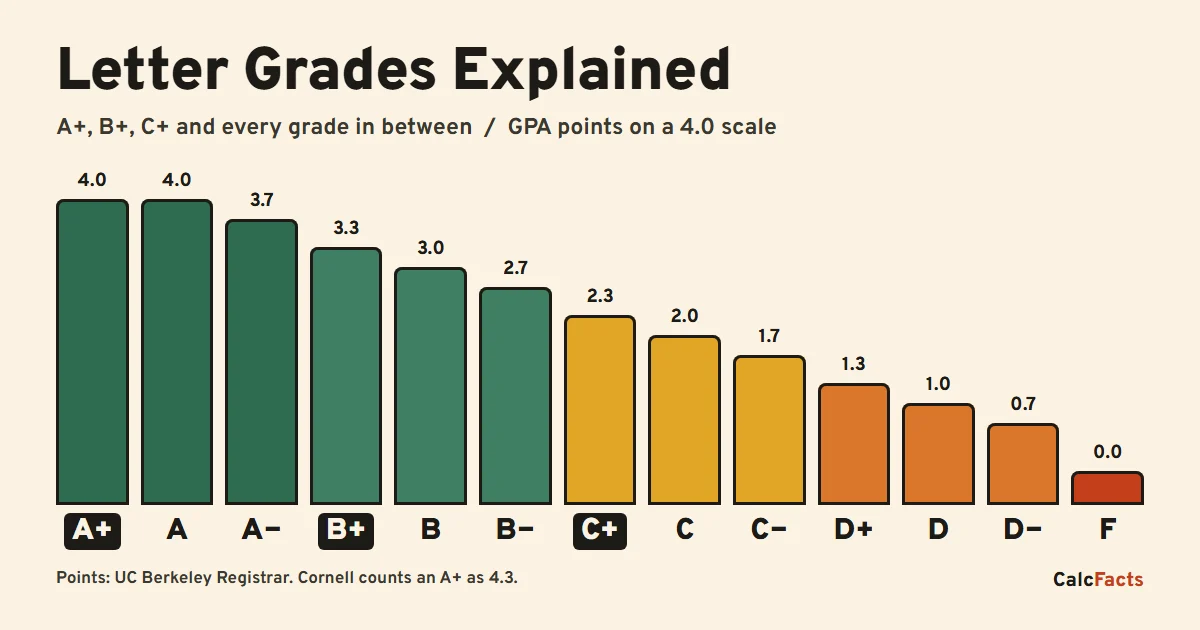
An A+ is the highest letter grade. On the common plus/minus chart, it covers 97–100%, but at many schools, including UC Berkeley, it’s worth the same 4.0 grade points as a plain A. A few colleges, such as Cornell, count it as 4.3, and many schools don’t give an A+ at all. A C+ is a passing grade one step above a C: usually 77–79%, worth 2.3 points on a 4.0 scale.
Those are the common values, not national rules. The U.S. has no single grading scale, so this guide shows the usual answer for each letter next to the real scales that a few schools and universities publish.
Last updated November 14, 2026 · Review: pending sign-off by an education reviewer (school counselor or teacher)
Key Takeaways
- A plus adds 0.3 points and a minus takes 0.3 away: B+ = 3.3, B = 3.0, B- = 2.7 (UC Berkeley).
- An A+ is often 4.0, the same as an A (UC Berkeley). Cornell counts it as 4.3. Alexandria City High School and Prince William County schools in Virginia, and Rutgers, don’t give one.
- A C+ is usually 77–79% and 2.3 points. Rutgers gives it 2.5 and has no minus grades.
- Any grade from D- up is usually passing, but many requirements ask for a C or better. For UC transfer, that means a C (2.00); a C- falls short.
In this guide
- Letter Grades at a Glance
- What Is an A+?
- What Is a B+ or a B-?
- What Is a C+?
- Is a C+ Passing? What About a C- or a D?
- How Plus and Minus Grades Change Your GPA
- Frequently Asked Questions
- The Bottom Line
Letter Grades at a Glance
The percentages below come from Alexandria City High School’s published scale in Virginia, which starts an A at 93%. That school has no A+ or D- and runs its D from 60% to 66%, so the A+, D and D- rows use the bands from the plus/minus chart on our letter grade chart. The points are UC Berkeley’s.
| Letter | Typical percent | GPA points (4.0 scale) | What it means |
|---|---|---|---|
| A+ | 97–100% | 4.0 (4.3 at some schools) | Top grade, not given everywhere |
| A | 93–96% | 4.0 | Excellent |
| A- | 90–92% | 3.7 | Excellent, low end |
| B+ | 87–89% | 3.3 | Good, high end |
| B | 83–86% | 3.0 | Good |
| B- | 80–82% | 2.7 | Good, low end |
| C+ | 77–79% | 2.3 | Fair, high end |
| C | 73–76% | 2.0 | Fair, average |
| C- | 70–72% | 1.7 | Fair, low end |
| D+ | 67–69% | 1.3 | Barely passing |
| D | 63–66% | 1.0 | Barely passing |
| D- | 60–62% | 0.7 | Lowest passing grade, not given everywhere |
| F | Below 60% | 0.0 | Failing |
Sources: Alexandria City High School; UC Berkeley Registrar. The meanings build on Berkeley’s words for each letter (A Excellent, B Good, C Fair, D Barely passed, F Failed); Florida’s law calls a C “average progress” and a D “lowest acceptable progress” (Fla. Stat. § 1003.437).
Your own school may draw the lines differently. Prince William County Public Schools, also in Virginia, gives an A from 92%, a B from 82% and a C from 72% (PWCS 2026-27). College Board’s example 4.0 table has no plus or minus grades at all, and it notes that your school “may calculate GPA differently” (College Board BigFuture). To look up one score, use the letter grade calculator.
What Is an A+?
An A+ is a grade above an A, for the very top scores. There’s no standard cutoff; on the common plus/minus chart it starts at 97%. The 100 percent grade page shows a perfect score on several scales.
On a GPA, an A+ often counts the same as an A. UC Berkeley says an A+ “represents extraordinary achievement” but “does not receive grade point credit beyond that received for the grade of A,” so both are worth 4.0 (UC Berkeley). Cornell is an exception: its transcript key lists an A+ as 4.3 (Cornell University Registrar).
Many schools don’t have an A+. Alexandria City High School’s scale tops out at an A for 93–100% (ACHS). Prince William County Public Schools’ scale tops out at an A for 92–100% (PWCS). Rutgers–New Brunswick’s undergraduate grades start at a plain A worth 4.0 (Rutgers catalog 2024–2026). At those schools, a 98% is simply an A.
So an “A plus” on a report card is a mark of distinction, but on an unweighted 4.0 scale it often doesn’t raise your GPA above an A.
What Is a B+ or a B-?
A B+ is the top of the B range: usually 87–89% and 3.3 points. A B- is the bottom of it: usually 80–82% and 2.7 points. A plain B (83–86%) is 3.0 (ACHS; UC Berkeley). See an 88 percent grade for a B+ on several scales.
Rutgers is a useful contrast: it has a B+ but no B-, and it counts the B+ as 3.5, halfway between a B and an A (Rutgers). A “B+ average” GPA is roughly 3.3 on the usual scale.
What Is a C+?
What percent is a C+? Usually 77–79%, worth 2.3 points: a passing grade just above a C, at the top of the C range (ACHS; UC Berkeley). Prince William County also starts a C+ at 77% (PWCS). At Rutgers, a C+ is worth 2.5 (Rutgers). See a 78 percent grade for the same score on several scales.
A C means “Fair” at Berkeley, “Satisfactory” at Rutgers and “average progress” in Florida law, so a C+ is a little better than average. A “C+ GPA” is about 2.3; the FAQ below has more.
Is a C+ Passing? What About a C- or a D?
Yes, a C+ is passing. Usually every grade from D- up passes the class. Florida law calls a D the “lowest acceptable progress” and an F “failure” (Fla. Stat. § 1003.437), and Berkeley defines a D as “Barely passed” (UC Berkeley).
But passing a class isn’t always enough. Many programs and requirements ask for a C or better:
- To transfer to the University of California, you need “a grade of C or better in each course” of UC’s seven-course pattern, or a Pass that’s equivalent to a C (2.00) (UC Admissions). A C- is 1.7, so it doesn’t meet that bar.
- At Berkeley, a Pass in a pass/no-pass class needs “C- or better” (UC Berkeley).
So a C+ clears both of those bars, while a C- clears Berkeley’s but not UC’s transfer rule. If a course is a prerequisite or part of your major, check the minimum grade it requires.
How Plus and Minus Grades Change Your GPA
On the usual 4.0 scale, a plus adds 0.3 and a minus takes away 0.3. Here’s one semester of four equal-credit classes, with and without plus and minus grades:
| Class | Plus/minus grade | Points | Without plus/minus | Points |
|---|---|---|---|---|
| English | A- | 3.7 | A | 4.0 |
| Biology | B+ | 3.3 | B | 3.0 |
| History | B | 3.0 | B | 3.0 |
| Algebra | C+ | 2.3 | C | 2.0 |
| GPA | 3.08 | 3.00 |
With equal credits, the GPA is the average of the points: 12.3 ÷ 4 = 3.075, or 3.08, against 12 ÷ 4 = 3.00. The A- cost 0.3, but the B+ and C+ each added 0.3. When classes have different credits, multiply each grade’s points by its credits first. The GPA calculator does this for you.
Weighted classes keep the plus and minus steps. At Alexandria City High School, a B+ is 3.3 in a regular class, 3.8 in honors and 4.3 in AP. A C+ is 2.3, 2.8 and 3.3. Grades of C- and below get no honors or AP bonus: a C- is 1.7 at every level (ACHS). To turn a GPA back into a letter, see the GPA scale. For how honors and AP bonuses work, see weighted vs. unweighted GPA.
Frequently Asked Questions
Is an A- a good grade?
Yes. An A- is still an A-range grade, usually 90–92% and worth 3.7 points. Berkeley calls an A “Excellent,” and an A- is the low end of that range.
What percent is a B-?
Usually 80–82%, worth 2.7 points. At schools with a 92% A cutoff, such as Prince William County, it’s 80–81.99%.
Is a C+ a good grade?
It’s a little above average. A C+ passes the class and meets any “C or better” requirement, but it’s below a B. For what colleges expect, see our guide to a good high school GPA; for how GPAs compare nationally, see the average high school GPA.
What is a C+ GPA?
A C+ average is about a 2.3 GPA on the usual unweighted scale (2.5 at Rutgers). In weighted classes at Alexandria City High School, a C+ is 2.8 in honors and 3.3 in AP. A 2.3 is below the 2.4 GPA in UC-transferable courses that the University of California asks of transfer applicants (UC Admissions).
Can you get higher than an A+?
Not as a letter. Extra credit can push a percentage above 100%, but it’s still an A+ (or an A at schools without an A+), and the GPA points don’t go above 4.0 on an unweighted scale, or 4.3 where an A+ counts extra.
Is a D+ passing?
Usually, yes. A D+ is typically 67–69% and 1.3 points, and D grades usually count as passing: Florida calls a D the “lowest acceptable progress.” It won’t meet a “C or better” requirement.
The Bottom Line
- An A+ is the top grade, usually 97–100%, but often worth 4.0 like an A, as at UC Berkeley. Cornell counts it as 4.3, and many schools don’t give one.
- A B+ is about 87–89% (3.3) and a B- about 80–82% (2.7).
- A C+ is a passing grade, usually 77–79% and 2.3 points (2.5 at Rutgers).
- Grades from D- up usually pass, but requirements often ask for a C (2.00) or better.
To see your percentage as a letter on several scales, use our converter. For more grade guides and calculators, visit the grades hub. To work out what you need on a final, use the final grade calculator.
Sources
- UC Berkeley Office of the Registrar, Grade Definitions.
- Cornell University Registrar, transcript key.
- Rutgers University–New Brunswick, Undergraduate Catalog 2024–2026: Grades and Records.
- Alexandria City High School (Alexandria City Public Schools, Virginia), Grading Scale.
- Prince William County Public Schools, 2026-27 grading scale.
- College Board BigFuture, How to Convert Your GPA to a 4.0 Scale.
- The Florida Senate, Florida Statutes § 1003.437 (2026).
- University of California Admissions, Transfer basic requirements.
About this guide: about us · editorial policy · contact
This guide is for general education. Grading scales vary by school; check your student handbook or registrar. Sources were reviewed on November 14, 2026.