
What Is a Good GPA in High School? (2026 Benchmarks)
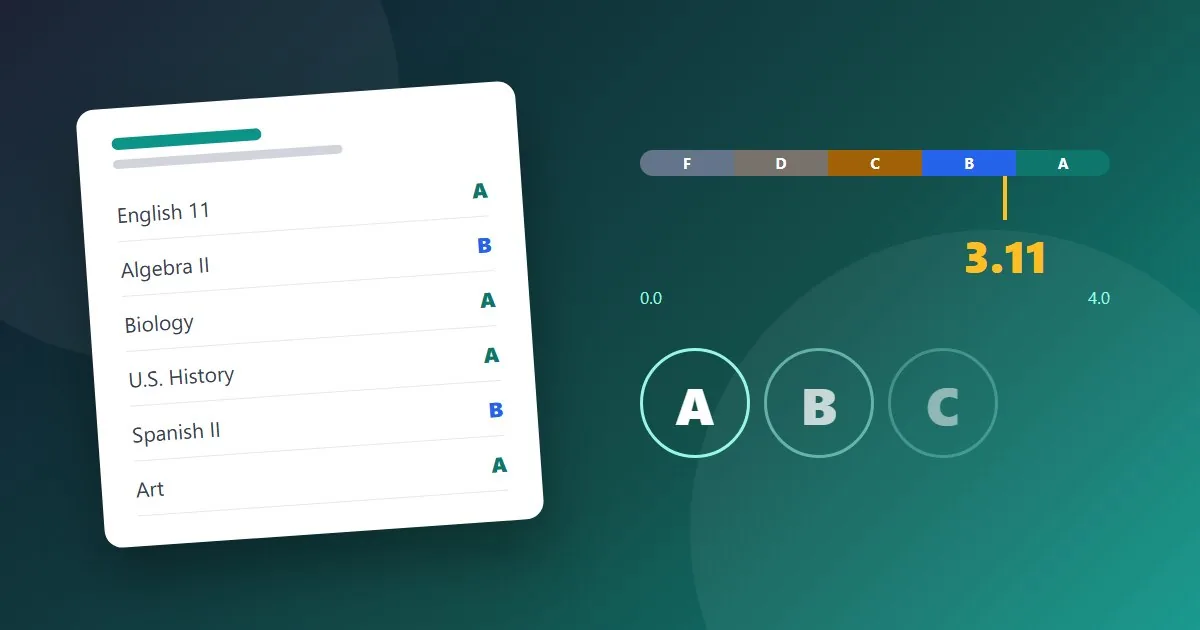
A good high school GPA is about 3.0 or higher on an unweighted 4.0 scale: a 3.0 to 3.5 is solid, and above 3.5 is strong. The average U.S. graduate earned a 3.11 in the most recent federal transcript study, which covered the class of 2019. That was the highest average on record. Still, “good” depends on your goal: a 3.0 meets the University of California’s in-state minimum, while highly selective schools like UCLA mostly admit students with a 3.95 to 4.00 unweighted GPA.
Below, you’ll find the national average, how weighted GPAs work, and what colleges look for. To check your grades class by class, try our grade calculators.
Last updated November 6, 2026 · Review: pending sign-off by an education reviewer (school counselor or teacher)
Key Takeaways
- A 3.0 to 3.5 unweighted GPA is solid; above 3.5 is strong.
- The average graduate GPA was 3.11 for the class of 2019, up from 2.68 in 1990.
- Grades are rising while test scores fall: 55% of ACT takers reported an A average in 2021, up from 40% in 2010.
- Weighted GPAs (above 4.0) follow school-specific rules, and many colleges recalculate your GPA on their own scale.
In this guide
- The Short Answer
- What Is the Average High School GPA?
- Is a 3.0, 3.5, or 4.0 GPA Good?
- How Weighting Changes Your GPA
- What GPA Do Colleges Want?
- Does Freshman Year GPA Matter?
- How to Raise Your GPA
- Frequently Asked Questions
- The Bottom Line
The Short Answer
Use this table to see roughly where an unweighted GPA stands. The ranges are our reading of the national data below, not an official scale.
| Unweighted GPA | Letter-grade average | What it usually means |
|---|---|---|
| 3.8–4.0 | Mostly A’s | Excellent; competitive at the most selective colleges |
| 3.5–3.79 | A’s and B’s | Strong; above the 3.44 average of mid-range ACT scorers in 2021 |
| 3.0–3.49 | Mostly B’s | Solid; close to the 3.11 national average |
| 2.0–2.99 | B’s and C’s | Below average; still passing, with room to improve |
| Below 2.0 | C’s and lower | Below many college minimums; worth a plan with your counselor |
Sources: NAGB, 2019 High School Transcript Study release; ACT Research Report R2134 (May 2022).
To see what one specific GPA means as a letter grade and a percent, such as a 3.0 or a 3.5, see the GPA scale.
What Is the Average High School GPA?
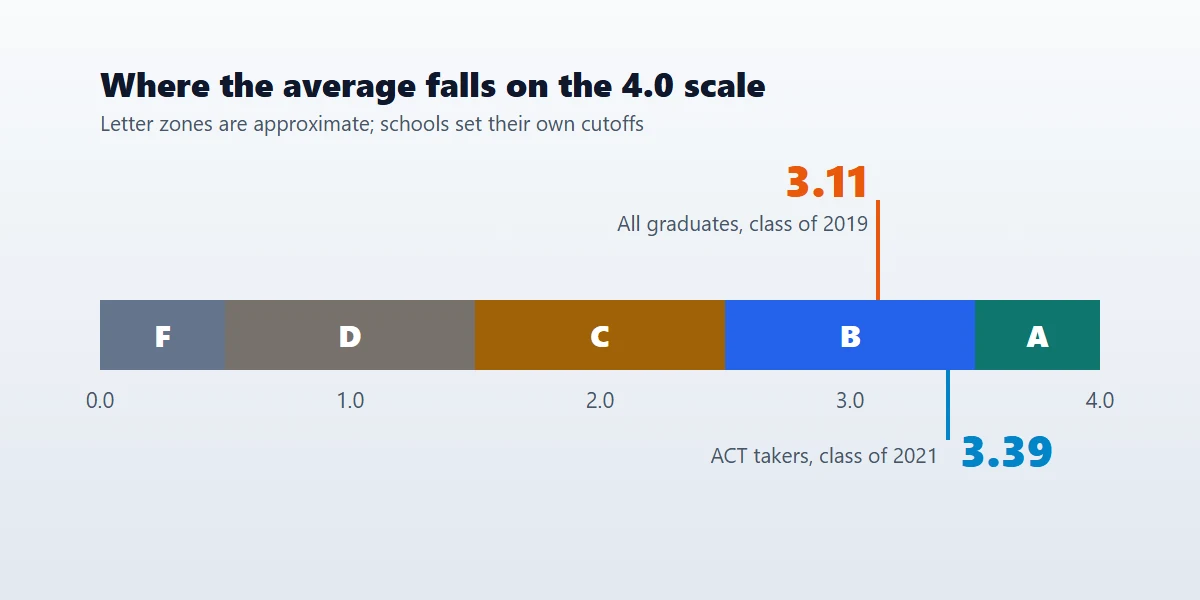
The average high school GPA was 3.11 on a 4.0 scale for the class of 2019, based on graduates’ transcripts in the federal High School Transcript Study, up from 3.00 in 2009 and 2.68 in 1990 (NAGB, March 2022). Students who take the ACT report higher grades: an average of 3.39 for the class of 2021, self-reported (ACT Research Report R2134). So a 3.5 is above average, but it’s no longer rare. For the full numbers, including averages by gender and race/ethnicity and why the two sources differ, see what the average high school GPA is.
Is a 3.0, 3.5, or 4.0 GPA Good?
Is a 3.0 GPA good?
Yes, it’s a solid, roughly average GPA. A 3.0 is a B average, just under the 3.11 national figure. It’s also the minimum GPA the University of California requires from in-state applicants (out-of-state applicants need a 3.4) (University of California). Meeting a minimum doesn’t guarantee admission, though.
Is a 3.5 GPA good?
Yes. A 3.5 sits right at the line between solid and strong. Here’s a useful yardstick: in ACT’s 2021 data, students who scored right in the middle of the ACT range (the 50th percentile) averaged a 3.44 GPA. Students at the 25th percentile averaged a 3.08, and those at the 75th percentile averaged a 3.69 (ACT R2134, Table 3). A 3.5 puts you a bit above mid-range test takers. At highly selective schools, though, most admitted students have higher grades.
Is a 4.0 good, and can you get higher?
A 4.0 unweighted means straight A’s, the top of the standard scale. You can go above 4.0 only on a weighted scale, where honors, AP, IB, or dual-enrollment classes earn extra points. UCLA’s weighted GPA, for example, has a maximum possible value of 5.00 (UCLA).
How Weighting Changes Your GPA
How does weighting work?
On an unweighted scale, an A is worth 4 points, a B 3, a C 2, a D 1, and an F 0, no matter how hard the class is. College Board notes that this conversion is common but “not necessarily a formula” every school uses (College Board BigFuture).
Weighted scales add points for harder classes, and the rules vary a lot by school:
| School system | Honors A | AP/IB A |
|---|---|---|
| Standard unweighted | 4.0 | 4.0 |
| North Carolina public schools | 4.5 (+0.5) | 5.0 (+1.0) |
| Broward County, Florida | 5.0 (+1.0) | 6.0 (+2.0) |
Sources: NC State Board of Education, GRAD-009 (2025); Broward County Public Schools.
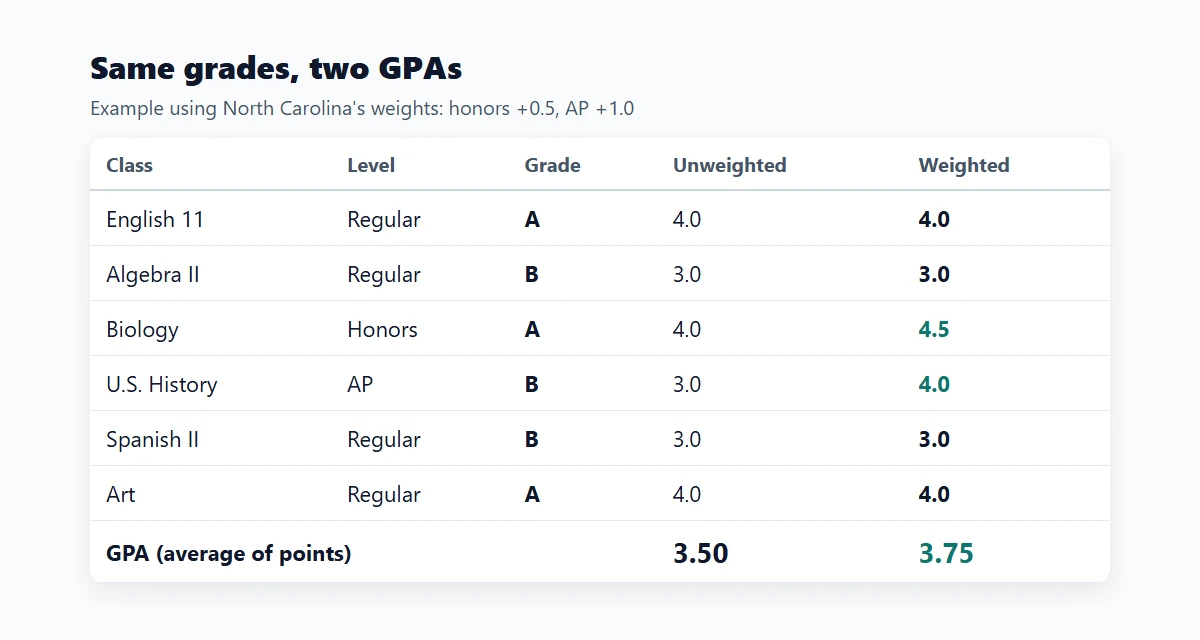
Here’s how that plays out. Take six classes with four regular grades (A, B, B, A), an honors A, and an AP B. Unweighted, that’s 21 points over six classes, a 3.50. With North Carolina’s weights, the honors A counts 4.5 and the AP B counts 4.0, for a 3.75. (This assumes each class is worth the same credit.)
So a 4.3 weighted GPA can mean very different things at two schools. North Carolina transcripts show both GPAs. For how to estimate one GPA from the other and how colleges recalculate, see our weighted vs. unweighted GPA guide.
Which GPA do colleges use?
Often neither one exactly. Many colleges recalculate your GPA. Miami University in Ohio, for example, puts every applicant on its own scale, where an honors A counts 4.5 and an AP or dual-enrollment A counts 5.0 (Miami University). The University of California counts only its required A–G courses and caps honors points (UC). That’s why your course choices matter as much as the number.
What GPA Do Colleges Want?
It depends on the college. Admitted-student ranges show how wide the spread is:
The range at UCLA is close to perfect: its fall 2025 admits had a median unweighted GPA of 4.00, with a 9% admit rate (UCLA). Miami University’s middle 50% for fall 2026 admits was 3.63 to 4.24 on its recalculated, weighted scale (Miami University). At the University of Georgia, admitted students for the class of 2030 typically had a core GPA of 4.13 to 4.40 and took 9 to 14 AP, IB, or dual-enrollment courses (UGA).
Rigor counts alongside grades, and these figures change every cycle, so check each college’s latest profile.
Does Freshman Year GPA Matter?
Yes, but usually less than later years. The UC system doesn’t count 9th-grade grades at all: its GPA uses A–G courses from the summer after 9th grade through the summer after 11th (UC). Many high schools still include 9th grade in your cumulative GPA, and colleges see the full transcript. A rough freshman year followed by steady improvement tells a better story than the reverse.
So what’s a good GPA for a freshman? The same benchmarks apply: a 3.0 is solid, and anything above 3.5 is strong. Freshman year is the easiest time to build a cushion.
How to Raise Your GPA
Small, early moves add up:
- Plan for finals. Find out the exact score you need to hit your target grade with our final grade calculator.
- Track every test. A test grade calculator shows what each score does to your grade.
- Know your class weights. If homework counts 20% and tests count 50%, focus where the points are. The weighted grade calculator makes this clear.
- Add rigor you can handle. An honors or AP class can lift a weighted GPA, but a low grade in it can hurt.
For how we convert grades and percentages, see our grading methodology.
Frequently Asked Questions
What is the highest GPA you can get in high school?
On an unweighted scale, 4.0. On a weighted scale, it depends on your school: UCLA’s weighted GPA maxes out at 5.00, while Broward County, Florida, gives 6 points for an AP A.
Do AP classes raise your GPA?
They raise a weighted GPA if your school adds points for AP courses, as North Carolina (+1.0) and Broward County (+2.0) do. They don’t change an unweighted GPA, where an A is a 4.0 in any class.
Is a 2.5 GPA good in high school?
A 2.5 is below the 3.11 national average, but it’s still a C-plus to B-minus average. Raising it is very doable, especially early: the UC system, for example, counts only 10th- and 11th-grade courses.
The Bottom Line
- A 3.0 to 3.5 unweighted GPA is solid; above 3.5 is strong.
- The latest federal average is 3.11 (class of 2019), the highest on record.
- Grade inflation means an A average is now common among ACT takers.
- Weighted GPAs depend on school rules, and colleges often recalculate.
Ready to see where your grades stand? Start with our final grade calculator, or browse all our grade calculators. You can also compare your number with the average high school GPA and our GPA calculator.
About this guide: about us · editorial policy · contact
This guide is for general education. Admission requirements and GPA policies change; confirm with your school counselor and each college’s admissions office. Sources were reviewed on November 2, 2026.