
Is Social Security Taxable? How Much, When and SSDI (2026)
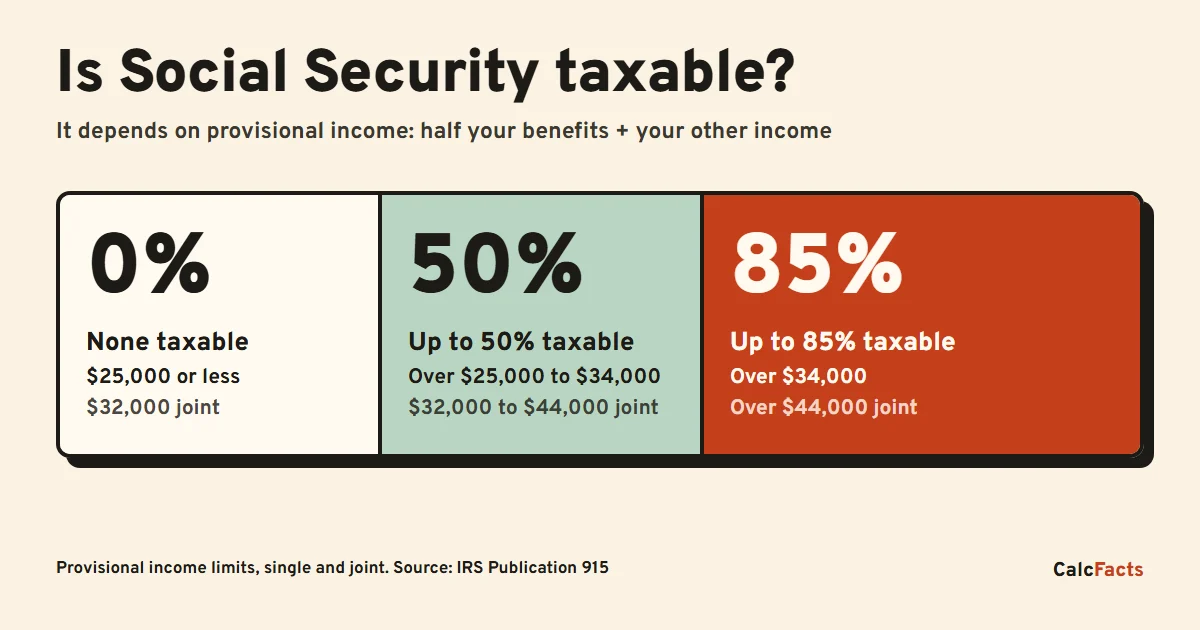
Yes, Social Security can be taxable, but only once your income passes a set level. Add half of your benefits to all your other income, including tax-exempt interest. If that total is $25,000 or less ($32,000 for married couples filing jointly), none of your benefits are taxed. Above it, up to 50% and then up to 85% of your benefits count as taxable income. No one pays federal income tax on more than 85% of their benefits (IRS Publication 915).
That makes the honest answer “it depends on your other income.” This guide shows where the lines are, how much becomes taxable at common income levels, how disability benefits and SSI are treated, what changed for 2026, and how states treat benefits. To run your own numbers line by line, use the taxable Social Security calculator.
Last updated November 8, 2026 · Tax review: pending sign-off by a licensed tax professional (EA/CPA)
Key Takeaways
- Social Security is taxable when half of your benefits plus your other income is over $25,000 ($32,000 joint; $0 if married filing separately and you lived with your spouse at any time during the year).
- Up to 50% of benefits can be taxable between $25,000 and $34,000 ($32,000 to $44,000 joint), and up to 85% above that.
- Social Security disability benefits (SSDI) follow the same rules. SSI isn’t taxable.
- For 2025 through 2028, people 65 and older can deduct up to $6,000 each, but benefits can still be taxable.
- California, Pennsylvania and the states with no income tax don’t tax Social Security.
In this guide
- When Is Social Security Taxable? The Income Limits
- What Counts as Provisional Income
- Is Social Security Disability (SSDI) Taxable? Is SSI?
- Is Social Security Taxable in 2026? The Senior Deduction
- Do States Tax Social Security?
- How to Lower the Tax on Your Benefits
- Having Tax Withheld from Benefits
- Frequently Asked Questions
- The Bottom Line
When Is Social Security Taxable? The Income Limits
Publication 915 compares half of your benefits plus your other income (often called provisional income) with two lines that depend on your filing status (IRS Publication 915):
| Provisional income | Single, head of household, surviving spouse* | Married filing jointly |
|---|---|---|
| None of your benefits taxable | $25,000 or less | $32,000 or less |
| Up to 50% taxable | Over $25,000 up to $34,000 | Over $32,000 up to $44,000 |
| Up to 85% taxable | Over $34,000 | Over $44,000 |
*Also married filing separately if you lived apart all year. If you lived with your spouse at any time during the year, the base is $0.
These amounts are written into the law (26 U.S.C. § 86) and aren’t adjusted for inflation, so as benefits and other income rise over the years, more of them can cross the lines.
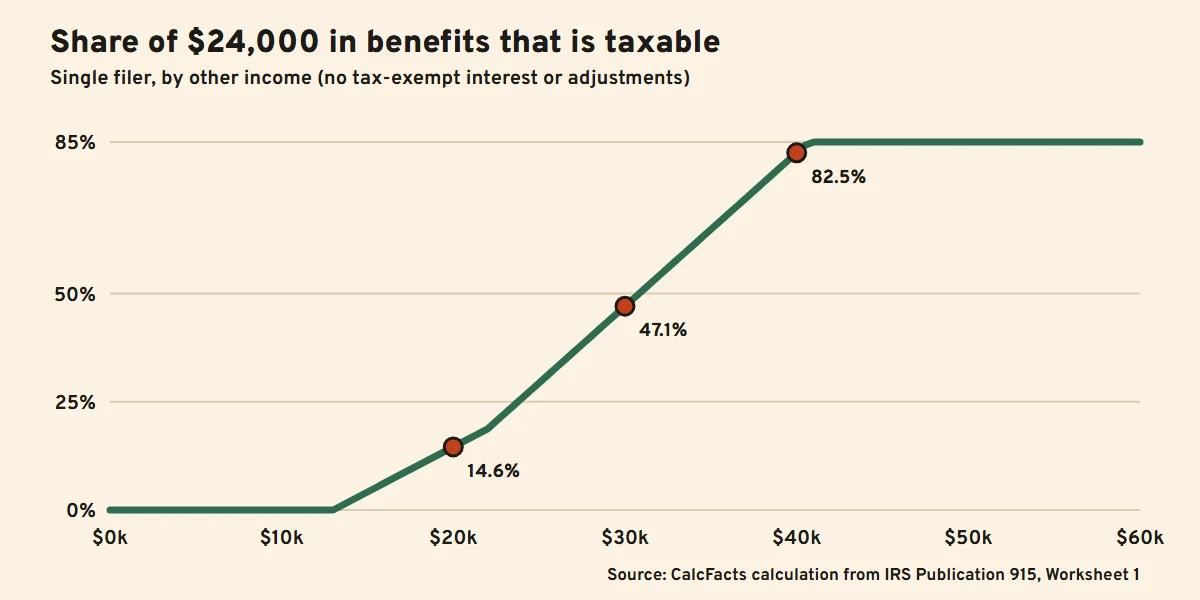
“Up to” is the important part. The IRS worksheet counts half of the income in the first band and 85% of the income above it, so most people end up somewhere between 0% and 85%. For a single filer with $24,000 of benefits a year:
| Other income | Provisional income | Taxable benefits | Share of benefits |
|---|---|---|---|
| $10,000 | $22,000 | $0 | 0% |
| $20,000 | $32,000 | $3,500 | 14.6% |
| $30,000 | $42,000 | $11,300 | 47.1% |
| $40,000 | $52,000 | $19,800 | 82.5% |
| $60,000 | $72,000 | $20,400 | 85% (the cap) |
Calculated with the CalcFacts taxable Social Security engine, which follows Publication 915 Worksheet 1 line by line. No tax-exempt interest or adjustments. Married couples: see the joint table in the taxable Social Security calculator.
“Taxable” doesn’t mean taxed at that rate. The taxable part is added to your other income and taxed at your normal bracket rates; see the 2026 tax brackets. To see what wages bring home after tax, use the paycheck calculator.
What Counts as Provisional Income
Provisional income (sometimes called “combined income”) is half of your benefits plus all your other income, including tax-exempt interest, minus certain adjustments to income. On the Publication 915 worksheet, other income includes (IRS Publication 915):
- Wages and self-employment profit
- The taxable part of pensions, annuities, and IRA and 401(k) withdrawals
- Taxable interest, dividends and capital gains
- Tax-exempt interest, such as municipal bond interest, even though it isn’t taxed itself
Adjustments to income, such as a deductible IRA contribution, the HSA deduction or the deductible half of self-employment tax, are subtracted. Student loan interest is the exception: the worksheet doesn’t subtract it.
For your benefits, use box 5 of Form SSA-1099: total benefits paid minus any you repaid. Don’t subtract Medicare premiums that were withheld; Publication 915 lists them among the amounts included in benefits paid.
Is Social Security Disability (SSDI) Taxable? Is SSI?
SSDI follows the same rules as retirement benefits. Publication 915 says Social Security benefits “include monthly retirement, survivor, and disability benefits”, so disability benefits go through the same worksheet, with the same $25,000 and $32,000 lines. With no other income, provisional income is just half of your benefits, so SSDI alone isn’t taxable unless it’s more than $50,000 a year ($64,000 for a joint return). A single person with $18,000 of SSDI and $15,000 of other income has provisional income of $24,000, so none of it is taxable.
SSI isn’t taxable. Supplemental Security Income is a separate needs-based program, and Publication 915 says SSI payments “aren’t taxable”.
Back pay. If you receive a lump sum that covers earlier years, which is common after an SSDI approval, you can figure the taxable part using each earlier year’s income instead, if that lowers your taxable benefits. Publication 915 calls this the lump-sum election.
Benefits paid for a child count toward the child’s income, not the parent’s.
Is Social Security Taxable in 2026? The Senior Deduction
It can be. The income limits above apply to 2026 exactly as before; the change for 2026 is a new deduction for older taxpayers. For 2025 through 2028, each person who is 65 or older by the end of the year can deduct up to $6,000 ($12,000 for a married couple who both qualify), whether or not they itemize (IRS Publication 6142).
Each $6,000 is reduced by 6% of modified adjusted gross income over $75,000 ($150,000 joint), so it disappears at $175,000 ($250,000 joint). You need a valid Social Security number, married couples must file jointly, and you claim it on Schedule 1-A (26 U.S.C. § 151(d)(5)(C); Schedule 1-A).
Headlines call this “no tax on Social Security”, but the worksheet hasn’t changed: up to 85% of benefits still counts as income. The deduction comes afterward and shrinks taxable income, so it cuts the tax owed on that income rather than the taxable amount itself. Take a married couple, both 65 or older, with $40,000 of benefits and $126,000 of other income: $34,000 of their benefits is taxable (the 85% cap), their estimated AGI is $160,000, and each of their two $6,000 deductions is cut by 6% of the $10,000 over $150,000, leaving $5,400 each, or $10,800.
Do States Tax Social Security?
Many states exempt Social Security, and some tax part of it, each with its own rules and income limits. Check your state revenue department’s guidance before you file.
Is Social Security taxable in California?
No. California doesn’t tax U.S. Social Security or tier 1 railroad retirement benefits, so you subtract the federally taxable amount on your California return. Foreign social security is different: California taxes it as annuity income (FTB Publication 1005, 2024).
Is Social Security taxable in Pennsylvania?
No. Pennsylvania lists “Social Security payments; railroad retirement benefits” among income items that are never taxable as PA compensation (PA Department of Revenue).
States with no income tax
States that don’t have a personal income tax, such as Texas and Florida, have no state income tax on any of their residents’ income, Social Security included. See states with no income tax.
How to Lower the Tax on Your Benefits
Because the tax depends on provisional income, the levers are your other income and your adjustments, all from the Publication 915 worksheet:
- Adjustments count. A deductible IRA contribution or HSA deduction lowers provisional income. In our single-filer example with $40,000 of other income, $4,000 of adjustments cuts taxable benefits from $19,800 to $16,400.
- Tax-exempt interest doesn’t help. It’s added back into provisional income. With $30,000 of other income, adding $5,000 of municipal bond interest raises taxable benefits from $11,300 to $15,550, even though the interest itself isn’t taxed.
- Timing of other income matters. Taxable income you control, such as traditional IRA withdrawals or capital gains, raises provisional income in the year you take it. Spreading it across years can keep more of your benefits in the lower bands. Required minimum distributions and Roth conversions count too.
- Claim the deductions you’re entitled to. At 65 or older, the senior deduction and the additional standard deduction for age (IRS Publication 554) lower the tax on whatever part is taxable (the additional standard deduction applies only if you don’t itemize).
Above $34,000 ($44,000 joint), until 85% of your benefits are taxable, each extra dollar of other income also makes 85 cents of benefits taxable, so your taxable income rises by $1.85 (compared with $1.50 in the 50% band).
Having Tax Withheld from Benefits
Federal income tax isn’t taken out of Social Security unless you ask. To have it withheld, give Form W-4V to the agency that pays your benefits and choose 7%, 10%, 12% or 22% of each payment (IRS Form W-4V). If you don’t have tax withheld, you may need to make estimated tax payments or have more withheld from wages or a pension (IRS Publication 505).
Frequently Asked Questions
What is the new senior tax deduction?
For 2025 through 2028, each person 65 or older can deduct up to $6,000 ($12,000 for a couple who both qualify), on top of the standard or itemized deductions. It phases out by 6% of modified adjusted gross income over $75,000 ($150,000 joint) and requires a Social Security number and, if married, a joint return (IRS Publication 6142).
What is the 50% rule for Social Security?
It’s the first band. When provisional income is between $25,000 and $34,000 ($32,000 to $44,000 joint), up to 50% of your benefits can be taxable: half of the amount above $25,000 ($32,000 joint), capped at half your benefits.
Is Social Security disability income taxable by the IRS?
Yes, under the same rules as retirement benefits: it depends on half your benefits plus your other income. SSI, a different program, isn’t taxable.
Are we going to have to pay tax on Social Security in 2026?
If your provisional income is over $25,000 ($32,000 joint), yes, part of your benefits is taxable in 2026. The new senior deduction of up to $6,000 per person can lower or remove the tax, but it doesn’t change how much of your benefits counts as taxable.
What percentage of tax is taken from Social Security benefits?
None, unless you request withholding with Form W-4V. You can choose 7%, 10%, 12% or 22% of each payment.
The Bottom Line
- Social Security is taxable once half your benefits plus your other income passes $25,000 ($32,000 joint).
- At most 85% of benefits is taxable, and the taxable part is taxed at your normal rates.
- SSDI follows the same rules; SSI isn’t taxable.
- The 2025–2028 senior deduction lowers taxable income but doesn’t make benefits tax-free.
- California, Pennsylvania and states with no income tax don’t tax Social Security.
For your own numbers, try the taxable Social Security calculator, which runs the IRS worksheet line by line.
About this guide: about us · editorial policy · how we calculate · contact
This guide is for general education and is not tax advice. Sources were reviewed on November 8, 2026. For decisions about your own return, consult a qualified tax professional.
Sources
- IRS Publication 915, Social Security and Equivalent Railroad Retirement Benefits
- 26 U.S.C. § 86, Social Security and tier 1 railroad retirement benefits
- 26 U.S.C. § 151(d)(5)(C), deduction for seniors
- IRS Schedule 1-A (Form 1040) and IRS Publication 6142
- IRS Form W-4V, Voluntary Withholding Request (Rev. January 2026)
- California Franchise Tax Board, Publication 1005 (2024)
- IRS Publication 505, Tax Withholding and Estimated Tax
- Pennsylvania Department of Revenue, PA Personal Income Tax Guide: Gross Compensation